The Singing Librarian’s 2019 in review – Theatre part 2: doing it


As ever, I haven’t “just” watched theatre this year, I have also been actively involved. I attended the NODA Summer School for the second year running, this year doing a brilliant course on Directing Musical Theatre. I haven’t yet had a chance to put this into practice, as all my theatrical activities this year have been on the stage.

A number of concerts have happened throughout the year, which have seen me sing songs including ‘True Colours’, ‘Empty Chairs at Empty Tables’, ‘Anthem’ and ‘Ac-Cent-Tchu-Ate the Positive’. The latter was part of Singalong Christmas, which sees us tell the story of the birth of Christ through a wide variety of songs – this one is sung by one of the shepherds, in case you were wondering.

I also performed in two musicals, and I am going to take them in reverse order.

A close-up of a pair of eyes, with the word EVITA written across them.

Promo image of Magaldi in Evita.

First, Evita, which was performed in the Autumn. This was my first time performing in an Andrew Lloyd Webber musical, and rather handily is my favourite of his well-known shows. I played the role of Magaldi, and became accustomed to saying “you know, the role played by Jimmy Nail in the film…”. I didn’t try to emulate Jimmy Nail (never try to copy a performance!), but tried to put my own stamp on it. The character doesn’t have much stage time, but he does memorably sing ‘On This Night of a Thousand Stars’. Twice. This role allowed me to unleash my vocals in a way I don’t usually do – the character is a singer, and a show-off at that. So I put every ounce of volume and embellishment into his big solo that I could find. I also had to hit some ridiculously high notes (without switching to falsetto) in one of the other numbers, which took a few people by surprise. The show was not easy, with tricky harmonies and some super-fast costume changes, but it worked really well.  The direction and design, along with the performances, created something rather special.

A man in a brown cardigan opening a large book.

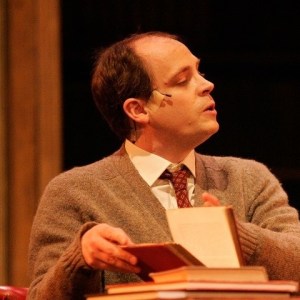
The Singing Librarian as Henry Higgins.

And before that was My Fair Lady, performed in the Spring. Yes, I’ve done this show before. But this time was different. Last time, I played Freddy Eynsford-Hill. This time, I played Professor Henry Higgins. This really was the role of a lifetime for me. I’m a character actor, not a romantic lead, so although I have played a fantastic variety of parts, the leading male role in a musical never seemed very likely. And what a role! So many fantastic actors have tackled this part before, and everyone thinks they know the character. He is, I realised, not a very nice man at all. His linguistic snobbishness is quite funny, as is his disdain of certain social conventions such as dressing properly for Ascot. But his attitude towards women, although often played for comedy, really isn’t funny, a fact which audiences can perhaps see more easily now. So a challenge – be true to the character without making him a villain. Enjoy the role and the songs without excusing his behaviour.

And I think it worked. I am as proud of my performance as Henry Higgins as I am of anything else I have achieved in the theatre. It was incredibly difficult, bringing me to tears at times, and I frequently doubted that I could carry it off (not least because at 40, I felt rather young for the part, even though the actor portraying him on Broadway at the time was about the same age as me). But on the night(s), it felt right. As the curtain came down, I knew that we had put on a great show, and that I had done the part justice. We got some fantastic feedback, too, including a glowing show report from NODA.

So two very different roles, which allowed me to prove (if only to myself) that I definitely can act and sing. 2020 has some excitement in store already in terms of my involvement with theatre. It has a great year to live up to!


The Singing Librarian’s 2019 in review – Theatre part 1: Watching it


About 20 theatre programmes scattered atop each other.

Some of 2019’s theatre viewing.

This has been quite a year for seeing shows. I have seen 4 West End musicals, 2 Broadway musicals (thanks to my most amazing housemates) and a whole host of other plays, musicals and pantomimes. This has included probably the best show I have ever seen, along with many other memorable moments.

When I see a show, I try to just enjoy it as an audience member. But parts of my brain inevitably end up watching it as an actor, a director, a stage manager, a writer. My mind is awash with “why did they do it like that?”, “nice lighting effect!”, “I wonder how often people spot that switch?”, “fantastic juxtaposition!”, “why was that scene needed?” and “ooh, cool segue!”. As well, of course, as the usual “wow!” and “yay!” and the occasional “bored now…”.

A couple of the shows I saw in London are fairly new musicals which have already established themselves as smash hits and likely to be classics that future generations revive over and over again. Hamilton was one of the slickest productions I can remember, with excellent timing, choreography and company work. Brilliant writing, too, which forces you to pay attention to lyrics delivered at breakneck speed. It struck me that there were many things in this very American show which echo some of the big issues in British society today – certainly I felt that there were things which would resonate with both Remainers and Leavers. And Come From Away, telling the story of Gander, Newfoundland in the aftermath of the 9/11 attacks, is both uplifting and heartbreaking. This too had brilliant company work, using simple costume changes and a few chairs to create a wide variety of people and places. Definitely the best thing I saw in the UK this year…

Locally, I saw some excellent productions as well. The Lindley Players at the Whitstable Playhouse produced some cracking plays this year. Beautiful ThingThe Woman Who Cooked Her Husband and Frankenstein were all engrossing and memorable with some spot-on performances. I saw Frankenstein in rehearsal (as I was on stage elsewhere during all of its performances), but even without lighting or full costume it was haunting and moving. I saw some original writing as well, which ranged from the sublime to the awkward. This included a brilliantly unsettling piece of site-specific theatre, Left Behind, performed in an attic, plus an unconventional murder mystery. I also saw a rare thing – a musical that I didn’t think should have been a musical. I won’t name it, but it was a case where the piece would have worked much better as a play which would have allowed the potentially fascinating story to live in a different way.

I travelled around England to see friends perform, direct and musical direct a range of shows. One of my friends turned in an astonishing portrayal of Judas in Jesus Christ Superstar (yes, I’m probably biased, but he was quite incredible). Others wowed me as fairy tale princesses in Disenchanted and a wide variety of jesters, fairies and more ordinary folk. I love a good pantomime (oh yes I do) and got to see three of them this year. Some of these were quite far away, but well worth the travel time to see friends being amazing and to shout, cheer and boo my head off.

Over in New York, we were lucky enough to take in 2 musicals – both excellent, but so very different. There was a different atmosphere to theatre in NYC, perhaps an extra crackle of anticipation in the air. The first show we saw was Frozen, which is brilliant at what it does. It takes a film which already had a highly theatrical score, and makes it work in a very different medium. The new songs add to it, with the standout being the bizarre ‘Hygge’ and the necessary ice and snow effects make for several “wow” moments – the most impressive being when Elsa’s ice powers spread across the theatre’s proscenium arch.

We then saw Hadestown. Definitely the best thing I saw this year and quite possibly the best thing I have ever seen in my life. It takes ancient myth and creates a tale for our time – despair and hope, victory and defeat, love and art and fear are all beautifully drawn. Someone near me in the stalls, probably around 20 years of age, said that she had been several times and this was her generation’s Rent. I didn’t get this at first, but when I talked about if afterwards, it made sense. There is a message of defiant hope, of perseverance against impossible odds and of faith when all seems bleak. This can speak so powerfully to the up and coming generation – a generation who have it all, and who have nothing. The richest ever generation materially, who often seem so poor in other ways, and who legitimately fear the future. These lyrics in particular speak to the growing feeling that there’s a battle which may be hopeless but will be fought nonetheless:

Some birds sing when the sun shines bright.

Our praise is not for them.

But the ones who sing in the dead of night.

We raise our cups to them.

I can’t explain why I loved Hadestown so much, but have never managed to articulate it. Everything just worked – writing, direction, performances, choreography, design, band, sense of occasion. In some ways it is so simple, in others so profound. It contained moment after moment after moment that I will never forget and which keep me thinking about them. About how these ancient stories seem so contemporary, and how hope can bloom in the darkest places. Perhaps it is impossible to explain, and perhaps that is the essence of live theatre – you simply have to be there.

To everyone involved in anything I saw this year, from the very best to the least impressive, and whether I have specifically named it here or not, I say a huge thank you. I was privileged to be in the room where each and every one of these performances happened. I can’t wait to see what the live stage brings in 2020 – if it’s even half as good as what I experienced this year, I’m in for a treat!

Not singing


For the first time since my Sixth Form days (way back in the 20th century!), I am acting in a play. True, in this century, I have played a whole host of characters in a pantomime, five operas and over two dozen musicals, but a play really does feel like a very different thing.  Some of my characters in these shows were non-singing, but I still added vocals to ensemble numbers, sometimes from the wings. I have always said that I approach a musical from the perspective of the words and the character, believing that if these are not in place, the music means nothing. But doing a play forces me to put my money where my mouth is. Can I act without music?

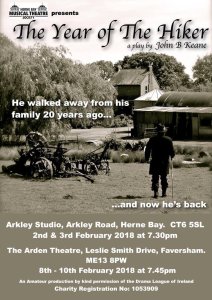
The play is The Year of the Hiker by John B. Keane. An Irish play first performed in 1963, it wasn’t one I’d ever heard of before. But I have grown to love it, as the characters have gradually revealed themselves during our rehearsal period. I am playing Joe Lacey, a young farmer who is forced to deal with some very complicated feelings. His father left 20 years ago, but returns in the play’s second scene. Joe has to work out how he feels about this and what to do when the reasons for his father’s return are revealed. He also has to negotiate a stormy relationship with his younger brother, and the conflicting demands of his other family members.

For the first act, Joe’s true feelings remain unseen. We see some flashes of anger, but not the reasons for them. We see that he doesn’t smile or laugh as much as his relatives, but we don’t find out why. This all comes out in a flood during the final scene, in one of the most emotional moments I have ever had to play. There is some resonance with characters I played in Footloose and When Midnight Strikes, dealing as they did with suppressed emotion in one case and serious daddy issues in the other. The balancing act of portraying a character who has all of this underneath the surface is hard – his eventual outburst needs to be surprising, yet not come out of nowhere.

When I do a musical, I can come offstage aching and sweaty. With the play, neither of these are true, yet I am still exhausted. Playing Joe is emotionally draining. And there are times during the play (particularly in the second act) when I don’t dare go back to the dressing room and sit down, despite having long periods offstage. To do that would break the spell – standing alone in the darkness backstage helps maintain my mood and focus. A musical requires a great deal of concentration too, but the need to stay in my character’s world here has a different quality to it, is more intense. I’m sure the professionals could cope much better, and snap into character in a moment, but I can’t, not for this. I need a bit of a run up!

Some audience members have told me that the show, and particularly one of my moments, has made them cry. I can’t remember anyone saying that since Footloose back in 2010. And there are times – not every time – when I really feel it, like a punch to the gut. I feel his hurt and anger, his bitterness, his incomprehension, his fortitude and later his lack of it. Some actors say they always experience this, that if they don’t feel the character’s emotions themselves, they can’t portray them. I don’t hold with that, but it is a powerful and somewhat frightening thing when it does happen to me.

It is often said of musicals that characters sing when words alone aren’t enough. Joe is a character who metaphorically can’t sing. He can hardly express himself in speech, and if an underscore were to start, I believe that there would be no melody, no harmony, no dance steps for him. His ability to sing and dance left him when his father walked out. He had to grow up overnight, and for Joe, part of that was leaving anything fun behind him. We get a hint that he had a social life, even a love life, once upon a time, but even that would have been a quiet, unemotional thing. As he puts it (speaking of filial affection) when he finally allows himself to sit down and talk to his father, “that kind of feeling isn’t in me.”

With two performances left, I am proud of what I have achieved here. I have proved to myself that I can act, not sing or perform (though I can do those things), but act. Take on a character and move an audience without the aid of music. And even when I’ve tied myself in knots with the script once or twice, I have been able to extricate myself and my fellow actors while remaining in character.

Will I do a play again? Absolutely. And hopefully it won’t be another 22 year gap between The Year of the Hiker and the next one, as there was between A Doll’s House and this. But I’m not going to give up musicals. Each is deeply challenging, each is deeply rewarding. The processes are much the same, but they feel so different and give differing qualities of satisfaction. I suspect I will remain a musicals man primarily, but now I know that I can be happy not singing.

The Year of the Hiker - flyer

Midnight Strikes again


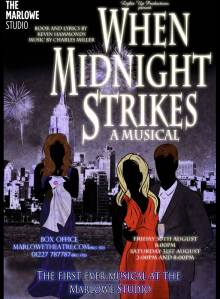
WMS 2013 flyer

Lightning may or may not strike twice, but midnight most certainly can. During the last two weeks of August, I revisited a show I first performed in during 2010, When Midnight Strikes. Although this production of the show was with the same company as the first (Lights Up Productions), there were many differences – only a few cast members were the same, it was performed in a different venue, and we put it together over an intensive nine days of rehearsals. For me, though, a key difference was that I was playing a different character. Quite a challenge, and quite a fascinating experience seeing the show from a different perspective.

Last time I did the show, I was worried about letting others and myself down because the role was so different to the sorts of things I usually do. This time, I was worried because the role was quite similar to my usual casting – a character who exists almost entirely for comic purposes, a function much needed in what is quite an emotional show. What worried me was knowing that the comedy needed to be funny, but my character, Edward, needed to remain real. It would be detrimental to the style of the show if he came across as a broad caricature, and given that I have played several parts recently where hamming it up was strongly encouraged, I didn’t want to give in to that temptation.

Edward is one of the outsiders at the party which the show follows. Although he was invited (unlike some of the eventual ‘guests’), he does not fit in, to the extent that even the host and hostess don’t really want to talk to him. He falls in love at first sight with another character, but is far too nervous to actually talk to her, and makes a number of social mistakes throughout the course of the evening. For me, to make him real, I had to live inside his world for the whole show and think whatever he was thinking, even if I was sitting on a chair at the back of the set. Whether he was trying to join a conversation, working out how to talk to his intended love, or wondering whether a shocking announcement was true, he was always thinking something. And although he sometimes put on a cheerful front (particularly once the alcohol had been flowing for a while), there was a profound sadness to him. He desperately wanted to fit in, but knew that he didn’t. Even when things began to go his way, in his/my mind, he couldn’t quite believe it was really happening. Most of these thoughts and feelings would have gone completely unnoticed by the audience, but they helped me a great deal.

Nine days of rehearsal was a tight schedule, but still allowed for plenty of character work alongside the technical necessities of working out who goes where and when everyone’s head should move in the ensemble numbers. We would often stop to work out what each character’s reaction to a particular moment was, and we were strongly encouraged to develop our own storylines when we weren’t directly involved with the action. As the show is set at a party, we were all on stage for much of it – what were we doing, thinking, feeling during those times when we weren’t talking or even when we weren’t aware of what was being said by other characters? The ensemble nature of the show meant that the 12 different personalities interacted in numerous (sometimes quite complex) ways, and exploring these was fascinating.

Our director and musical director were both very keen on details. There were times when we all had to breathe in a song, regardless of whether we needed to take in air. There were head movements that had to happen at exactly the same time. Certain props needed to move from one place to another at exactly the right moment. Good enough was not good enough – we were aiming higher than that. All of this (in addition to the individual details) helped bring the ensemble together as a true ensemble. By the time we arrived in the theatre, the whole team (actors, musicians, stage management etc) was a team. We were all doing this together and it was worth doing.

We know it was worth doing from the reaction we’ve had since. People really enjoyed the show, and fed back positively about everyone involved. There really wasn’t a weak link in the cast (if we’re honest, we all know that there usually is, and we always know who it was) and it is a privilege to have been involved with the production. We coped with some major challenges, both emotional and technical and put on a great piece of theatre. Personally, I know I made a far better Edward than Christopher (the role I played last time). There are still things I’d like to have done better, but this was definitely a productive use of two weeks of my annual leave. There aren’t many shows I feel the need to revisit, but I would happily have midnight strike a third time in my life.

++++++++++++++++++++

Related posts (about When Midnight Strikes, the first time around):

Recording – Apparition Smith and the B Musical.


Although I have performed in everything from seventeenth-century opera to recent shows which began life on Broadway or the West End, it is particularly exciting to get to sing something which nobody else has sung before.  New works I’ve performed in include the Christmas oratorio Prepare the Way by Phil Hornsey and the musical Behind Closed Doors by Stephen Clee.

Last year, I was contacted by Ethan Lewis Maltby, who I know from performing in the ensemble of his musical Courtenay. He was recording material from 3 of his shows, and asked me to participate in two of them.  Firstly, B Musical, a science-fiction piece about the alien invasion of a small town.  And secondly, Apparition Smith, a 19th-century tale about a group who put on fake séances. The material from B Musical had been recorded before, though the show has yet to be performed, and the pieces from Apparition Smith were as yet unheard.

This was exciting – it was great (and rather flattering) to be asked to take part and exciting to sing something new.  I therefore spent some time learning the music and a few evenings recording it.  Recording is an unusual experience – there is no audience to play to and the environment is a strange one. Unlike in live performance, there is nothing you can do to hide, but you can go back and fix even the slightest error, and do it as many times as is necessary to get it just right. Of course, this didn’t mean that I didn’t get annoyed with myself when things didn’t go right – quite the reverse! There were bits of the section I sang in B Musical which made me more and more cross with myself as I struggled to get them right. Ethan and Jenna (the lyricist for Apparition Smith, who also did the sound engineering – a skill I am in awe of) were very patient, but I dread to think how many attempts we must have made.

A little while later, the results of everyone’s work were released, and sound great!  They have been made available on-line, and I really hope that they lead to the shows being picked up for production – I would be happy to see any one of them on the stage.  Each has its own website:

  • Apparition Smith. The tale of Nathanial Smith, a charismatic conman who travels 19th-century Britain setting up fake séances. I can be heard on the tracks ‘The Legend of Apparition Smith’ as a Legend-Teller and ‘Setting Up For a Séance’ as Ed.
  • B-Musical.  A comedy about a typical American family who have to deal with the somewhat unexpected arrival of aliens in their community. I play the part of Pa, and can be heard on the tracks ‘Strangeness About’ and ‘Tantrum’
  • Courtenay. The true story of the remarkable Sir William Courtenay and of the last battle fought on mainland English soil.  I don’t sing on this one, but you won’t regret checking it out!

If you’re curious about what singing librarians sound like, have a listen. If you like checking out new writing in musical theatre, have a listen. If you… well, just have a listen. Ethan and his lyricists are talented people, and their work deserves to be heard and seen.  The three shows have very different sounds and styles and offer proof (if proof were needed) that there is great work in British musical theatre going unheard.

If you are particularly pressed for time, I am most pleased with ‘The Legend of Apparition Smith’. Most unusually, I can listen to that track without feeling embarrassed about hearing my own voice. You could possibly even say that I’m proud of my work there – an astonishing feat worthy of Apparition Smith himself!

The Singing Librarian – being both


singinglibrarianI’m a librarian. I’m a performer. And being both makes me better.

Librarians have a key body of professional knowledge and a set of professional skills. If we didn’t, there really wouldn’t be much point to us.  Performers, too (whether professional or amateur) draw upon a set of skills and a body of knowledge.

In the case of librarians, the perception may be that we rely largely on knowledge rather than skills.  This is not really the case.  In terms of finding information on-line, for example, we don’t learn the ins and outs of every search engine, digital library, repository or on-line archive. We draw upon skills that we have learned (formally or otherwise) and then honed through experience to help us when we encounter new resources. Similarly, the ability to work out exactly what it is that someone is actually looking for is a skill.  On the other hand, performers do not (or should not) rely entirely on skill. There is a body of knowledge to draw on in terms of creating a character, using voice and so on. Perhaps more importantly, theatre has a language, etiquette and culture that have to be learned – sometimes, knowledge of this can avoid injury, so it’s rather important.

But how do the knowledge and skills from each side of my life relate to each other? In many ways, but in order to keep things relatively short, there are five main areas where I see my performing activities and my library work intersecting: memory, adaptability, use of voice, confidence and organisation.

Firstly, memory. It is a common misconception that librarians know everything – our job (or at least my job) is to help other people access information, not to know the answers for them. However, I find it is useful to have a lot of information ready to retrieve from the mental filing cabinet – whether that is the status of particular book orders, the location of books on the Spanish civil war or the best database to use for locating information on CTG. In my other activities, memory is just as vital. Lines, harmonies, dance steps, location of clothing for quick changes… the list of things to remember during a show is worryingly long. Thankfully, I am usually a quick learner, and I think this may be partly due to my work-life combination.  Each side of me exercises my memory storage and retrieval capacity, though in different ways, and so each side of my life enhances the other.

Secondly, adaptability. Sometimes, in theatre, things just don’t go the way they should. Someone forgets to enter for a particular scene, a prop shatters as you pick it up, words get jumbled or a follow spot operator has a bad day. As a performer or member of the technical crew, you just have to cope and carry on, preferably without most of the audience realising that anything went wrong at all. This is relevant in library life surprisingly often. I have to demonstrate various websites, software packages etc. to many different people, sometimes one-to-one, sometimes in lecture theatres. And, of course, things go wrong. A site goes down for maintenance, the internet connection decides on a go-slow or the network cuts out entirely. In these instances, I don’t pretend that nothing is wrong, but I either have to keep the audience entertained (as it were) or come up with an alternative plan. Improvisation is an important skill!

Thirdly, use of voice. As I don’t tend to engage in mimed performances, the use of my voice is rather key to the performing part of my life (most obviously when singing). I therefore know how to project my voice, and have strategies I can fall back on to keep my voice going when it’s tired.   I do so many lectures and workshops on campus that this is extremely important to me in the work environment as well. We have two training rooms in our library, and one of these has a microphone that can be used. I always book the other one to leave the mic. available for colleagues. I’m not a naturally loud person, but I know how to make myself heard. And when there are times of year when you go from workshop to lecture to tour with barely any breaks, being able to take care of your voice is important.  The techniques I’ve learned as a performer have thus been invaluable as an academic librarian.

Fourthly, confidence. I am not confident when meeting people I don’t know, or when being myself in front of people. On the other hand, I am (in some ways) confident when I get up and perform as a character. That may say all sorts of things about me psychologically, but the strange “I’m terrified, but nobody can tell” confidence I have on stage can translate into work situations, such as large lectures. To a small extent, I take on a character. His name is David and he’s a librarian. Yes, he’s me, but being able to perform in some way helps make the whole thing less disturbing. I also tend to leaven my presentations with a light sprinkling of humour, as any public speaker probably should.

Lastly, organisation. Unlike many of my colleagues, I’m not one of the world’s tidiest people, but as a librarian, I do have a certain professional appreciation for order, for the proper arrangement of information, for categorisation and sequencing. This can help me as a performer, particularly if a show has a myriad of costumes or other items to keep track of – everything has its place and all is well. It’s even more useful in other aspects of theatre. As a director or a stage manager, I am super-organised. I have lists and spreadsheets and diagrams and more lists.  Yes, there’s certainly plenty of room for creativity and spontaneity (lists can always be re-written), but the librarian approach to life definitely makes me more efficient and effective in the theatre. Managing and organising information is not a pointless skill beyond the walls of the library, it reaps bounteous artistic rewards!

Of course, none of these things are unique to librarianship or to performing, but it’s interesting how they interact and how different parts of my life feeds back into others. I firmly believe that as the Singing Librarian, I am stronger – librarianship helps make me a better performer, and performing helps make me a better librarian.

Beyond the dilemma of the work-life balance, how do your leisure activities impact on your work? Or vice versa? I’d be fascinated to know – leave a comment!


A free day in the library


Earlier this week, I mentioned to one of my friends that I had a day coming up where my work diary was empty.  This is a rare occurrence, as (even during July) the working week is liberally sprinkled with workshops, demonstrations, meetings and one-to-ones.  When I mentioned this, my friend then asked me what I do on ‘empty’ days, particularly when most of the students are off on holidays.  I expected to get at least one student ask for some help, but that didn’t happen.  Here, though, are the things which filled my working day when the diary was empty:

Stock moving. We have two collections of books moving to our library over the summer, so we’re having to make space for them.  To that end, everything else has been shifting around in the library, and on this particular day I helped to shift some of the history books.  This particular work helped free up some space in a particularly squashed area of the library, but will also have the knock-on effect of freeing up some shelves for the collection of music scores which is coming our way.

Writing. Our library is involved with many of the local schools, offering access to the building as well as training in information skills to sixth form students.  We give them lots of different handouts etc when they come, but we’d like to condense that down into one booklet.  On this day, I worked on the page about choosing appropriate keywords to help in the search for information.

Web editing.  I am one of the library’s team of web editors.  I made a number of small tweaks to the web site, including correcting a few rogue spellings, adding a link to a useful external website and tidying up some of the information on borrowing books.  I also made some changes to my subject guide pages – some factual updates and an attempt to integrate my Twitter feed in a visually pleasing manner.  Unfortunately, I have discovered that my method for doing the latter is not effective on small screens.  Back to the drawing board…

Searching.  I have been involved with a project to introduce reading lists management software to the campus.  The discussions I have had with academics and fellow librarians have made me curious about the impact of reading lists in general.  I therefore spent a small amount of time trying to locate any research which may have been done in this area.  Initial findings suggest that not a lot has been written on the topic, but I did find some interesting articles to read.

Updating.  I also updated several reading lists using said software.  The intention of the project is to hand responsibility for reading lists over to academics, but we’re in a transition phase, so I’m still doing bits and pieces.  Thankfully, it takes mere seconds to add items to lists (or remove them from lists, for that matter).

Line managing.  I approved a leave request from one of the three people I line manage.

Checking. An academic in the process of revalidation for one of her courses sent a set of reading lists through to be checked, in order to see which items are currently available through the library at my campus, another campus or electronically.  I was able to complete this by the end of the day, though checking to see what copies of the missing books would cost had to wait until two days later.  Checking these lists also allowed me to practice use of a new resource discovery system – I had previously been using it primarily to locate electronic material. Confusingly, these lists will not tie up with the reading lists project – I work for three universities at once, and only one of them has the reading lists management software.

Preparing. Various bits of preparation needed to be done.  I finalised my travel arrangements for a visit to a different campus the next day, along with what I was supposed to be doing when I got there.  I discussed the content of a training session (to be held in two days time – just a little bit of time pressure there!) with an academic. And I added the dates of some demonstrations and workshops to my diary.  These were for September and October, but I already have numerous dates booked in for 2014.

Quite a full day, with a variety of tasks. There is always a lot to do in my job, even when things are supposedly ‘quiet’.  I wasn’t able to remove much from my to-do list (which somehow ended up longer at the end of the week than it had been at the beginning of the week), but I still felt that the day was a productive one. And although I always say that the best bit of my job is face-to-face work with students, it was still an interesting day. So there we have it. That’s what the Singing Librarian does when there’s nothing in his diary. I can be fairly sure, though, that the next clear day will be filled with an entirely different selection of activities.

New things


It’s a season of new things in the life of the Singing Librarian. Of course, January is often a season of the new for many people, but there is no deliberate New Year impetus here.

The first area of new things is in terms of reading (having accidentally abandoned my month-by-month review of what I’d been reading, regular readers may be reassured to know I haven’t given up on books!). I seem to be alternating my general diet of fiction with a little more fact, including books on librarianship, philosophy and language. I have always read such books, but I’m picking them up a little more frequently these days. My fiction diet has widened as well – during January, I have already read work by W. Somerset Maugham, Armistead Maupin and China Miéville for the first time. I really enjoyed all three, and have already begun raiding the library shelves for more by the last two.

The other area for newness is the area of education (which, I admit, does rather overlap with reading!). I am trying out some new things in the information literacy sessions I teach and I am expanding my own horizons in terms of professional development. I have signed up for a MOOC (Massive Open Online Course) from the University of Edinburgh entitled E-learning and Digital Cultures. This is a 5-week on-line course which starts next week, exploring on-line learning in a variety of interesting ways. As a number of the courses I support are taught at a distance and as almost all of ‘my’ students spend some time away from the university environment on placement, I am particularly interested in e-learning and what role (if any) it can play in the information literacy teaching and training I provide. I’m also interested in the concept of MOOCs as a whole, and doing one seems the most sensible way of understanding them. Enrolling on the course has already got me to sign up to Google+ for the first time.

I have also made plans to pursue a scheme at my workplace which would give me recognition for my contribution to learning and teaching and also, if successful, lead to Associate Fellowship of the Higher Education Academy. This will require a lot of work, gathering evidence about what I do and how it contributes to higher education learning and teaching. It’s not going to be easy, but even if I am not successful, it will be worth pursuing, as it will force me to reflect on my professional work more than ever, and the required reading will teach me an awful lot as well.

In addition to all of this, I am trying to understand the world of Open Access publication of research, which has led me to read all sorts of interesting things.

So, new things. Time-consuming new things, at that! I’m still keeping up the old things, though, which means my time management skills will have to develop at a rate of knots…

Calming the paranoid librarian


I seem to have subscribed, accidentally, to the paranoid school of librarianship.  This means that, despite my ‘nice feedback’ folder of job-related positive emails and despite coming up to 2 years in post, I end up worrying more and more.  The worst manifestation of this occurs if I have a meeting with people from outside the library, particularly one that’s not part of the regular routine of my job.  I often enter the room fearing that someone is going to turn round and tell me I’m doing a terrible job and they wish they had a different librarian.  Days with multiple meetings are therefore extremely tense.

For the most part, meetings are actually rather positive.  I know (and the students and academic staff know) that there are limits to the wonders I can achieve, but most groups seem quite happy with the work that I do.  Some courses are a little less reluctant to work with the library than others, but I have only ever had one student outright say that I personally was doing a bad job, and that was (I think) at least partly a reaction to me refusing to break the law for him.  I’m annoying like that, you see.

Having spent much of the week in impending doom mode, I had a revelation on Friday afternoon that the groups of people I find it hardest to work with tend not to work well with anyone outside of their group anyway.  Which is fair enough – people who we perceive as “other” in some fundamental way, not in terms of race or sexuality so much as in terms of being in some sense “like me”, can be hard to understand, due to having minds that work in very different ways.  Different, not better or worse.  And it works both ways – I need to see their worldview in order to help them see a bit of mine.

I also thought it was about time to go through my ‘nice feedback’ folder again.  Don’t worry, I’m not going to regurgitate it all here, but the first and last items in there are wonderfully different.  The most recent is from the end of October, from an international organisation.  Some librarians from Nigeria had been visiting them, and as our library was nearby, they came for a tour.  As they were interested in web 2.0 and its possibilities in libraries, I was tracked down and asked to speak to them.  My manager forwarded the subsequent letter sent by their organisation to me as it included this :

I would particularly like to thank [the Singing Librarian] for the talk he gave at such short notice.  This was delivered very well…

Aw, thank you!

The earliest item in there is from around 4 months after I started in the post, just after my first new intake of students and therefore my first intensive round of planned lectures, workshops and the like.  Our library holds a user group, and I received an email after this informing me that a member of staff wanted to minute that the

students were singing your praises about the support that they had received from you at their workshops and when they have called into the library to see you.

Which is nice.  It is relatively rare for the role of the library and its staff to be acknowledged officially, apart from when things go wrong.  I am lucky to work, across the 3 universities my role covers, with some exceptional people who do brilliant work.

So why have I written this blog post after yet another long silence?  Well, regular readers will know that my confidence levels are subject to many fluctuations and I’m sure I’m not alone in that.  I wanted to recommend a ‘nice feedback’ or ‘lovely emails’ folder for everyone – you can’t be perfect all the time (and I am well aware of the aspects of my job which I’m still not great at), but it’s good to be able to remind yourself of the positives if you tend to accentuate the negative.  Now, if you’ll excuse me, I have a bunch of other nice messages to read through…

Superhumans and national pride


I’d imagine very few people in the UK are unaware that our capital has been playing host to the Olympic Games over the last two weeks.  The newspapers, television and radio have been full of little else and it has proven to be a topic which can enliven even the most awkward lull in conversation.  And now we have a brief lull before the Paralympics and…then what?  Certainly the journalism industry is going to have to look a bit harder for news items to fill their pages and minutes, if nothing else.

I always rather enjoy the Olympics. I’m not much of a sports fan, but the coverage of a collection of very different sports, with the opportunity to watch just brief snippets of each is wonderful.  And the idea of the world coming together for a fortnight of friendly(ish) competition is even better.  There’s the joy of seeing countries you’ve barely heard of earn a medal or two, and the way in which the entire country can suddenly become experts on fencing, synchronised diving or the pole vault if it looks like a British athlete stands any chance in the sport du jour.  Having it in my own nation adds a bit of patriotic pride and excitement to the mix, even though I didn’t even enter the ballot for tickets, let alone attend.

The whole thing got off to a simply stunning start, with an opening ceremony which showed off the things which this strange little country is so proud of and showed an amazing theatricality.  I was in awe at the Pandemonium segment where chimneys rose from the stadium floor and the Olympic rings were forged in the sky, I grinned with delight when the Queen met James Bond, I felt inordinately proud of the NHS, our musical culture and the eclectic, multi-ethnic randomness of British society.  I felt quite emotional watching it, and indeed shed a tear towards the end.  The moment when it became clear that the cauldron would be lit not by a world-famous athlete, but by seven young people that most of us had never heard of made me glow with excitement – the symbolism of passing the torch on to the next generation and the thought of what those youngsters must have been feeling really struck me.  But I wasn’t prepared for the sheer beauty of those copper petals rising and coming together to form that beautiful cauldron.  Simple, yet utterly beautiful.  Add the fact that each petal was brought in by a different country, and I was gone.  That moment exemplified what the Olympics should be for me.

Then the actual competition got underway.   I saw bits of diving, gymnastics, handball, athletics, tennis, swimming, fencing, rowing, cycling, sailing, water polo and probably other sports which I’ve forgotten about.  As each event continued, I was in awe of what these people could do.  Even the last placed competitors were doing things which you wouldn’t think would be humanly possible – so fast, so high, so strong, not to mention so long, so graceful, so controlled, so coordinated and so on.  Whether I enjoyed the sport or not, I found myself open-mouthed time after time.  I also found myself shouting at the commentators and interviewers quite frequently.  They often seemed distinctly disappointed if the British hopes got anything less than gold (for shame, they’re only the third best athlete in the world!), even if it was a surprise that said competitors even made it to the finals.  And in one swimming relay, the commentator shouted “oh no!” – a team had won gold and broken the world record, but they still hadn’t gone quite as fast as he’d hoped.  I’m sorry, but they’ve just swum faster than any other team in history, and you’re disappointed?  Madness!

The things I’ve seen blew my mind.  In the diving, I was impressed simply by the control in their handstands, let alone what twists and turns they went though on the way into the pool (where they somehow have to avoid splash).  The table tennis moved too fast for me to follow.  The long jump covered ludicrous distances, and the pole vault is mind-boggling.  Men and women carrying on through serious pain, and everyone (apart from maybe a few badminton duos) giving their all even if they were so far behind the rest of the field.  Concentration, determination and humility.  And yes, some very large egos as well.  The Paralympics will be just as awe-inspiring, I have no doubt.

The closing ceremony didn’t quite live up to the opening ceremony, partly because it didn’t seem to hang together as well.  It did have some excellent moments to it, though, particularly the opening segment with the newspapers and street parties, and the inspired pairing of Jessie J with Queen.  It did continue to prove the point that this country has produced some amazing music and musicians, though.  Lord Coe’s speech was obviously quite emotional for him, and it would be hard to argue with his assertion that “we did it right”.  While marvelling at the abilities of athletes from around the world, arguing the merits of various sports and enjoying the warm, fuzzy feeling which comes from the world coming together, the 2012 Olympics reminded me that this country (while far from perfect) is capable of being truly amazing.