The Privilege Meme


Memes don’t often tickle my fancy, but this particular one, though unconnected with any of the usual subjects of the blog, struck me as rather interesting.  I came across it as it floated through the blogosphere, invading such blogs as Charlotte’s Web and floatykatja’s Pina Colada Blog.  It was devised by PhD students at Indiana State University – Will Barratt, Meagan Cahill, Angie Carlen, Minnette Huck, Drew Lurker, and Stacy Ploskonka. If you participate, they ask that you please acknowledge their copyright.

Bold the true statements. You can explain further if you wish.

1. Father went to college.
2. Father finished college.
3. Mother went to college.
4. Mother finished college.

I’m assuming that college is in the American sense of higher education, rather than the British sense of further education (and some higher education institutions). Mum has sundry academic qualifications. Dad doesn’t, but has gained membership of various chemistry-related professional bodies through experience.

5. Have any relative who is an attorney, physician, or professor.
6. Were the same or higher class than your high school teachers.
I suppose so – I’d classify my family as middle class. The professions of parents, uncles, aunts and grandparents that I know of are teacher, quality control officer, telephone engineer, secretary, mechanic, chef and book keeper.

7. Had more than 50 books in your childhood home.
8. Had more than 500 books in your childhood home.

9. Were read children’s books by a parent.
I’m not entirely sure how many books we had at home, but enough to fill several bookcases downstairs, plus quite a number of books for us young ones in our room. I don’t actually remember being read to, but I know I was and am grateful for it – how can a child who is not read to develop a love of reading?

10. Had lessons of any kind before you turned 18.
11. Had more than two kinds of lessons before you turned 18.
Well, this is interesting, and it rather depends how you define lessons. I did all sorts of things as a member of the Boys’ Brigade, and received proper instruction in canoeing and sailing as part of this – I even have the certificates to prove it. Private lessons, though? No. Not for music, sport or anything else.

12. The people in the media who dress and talk like me are portrayed positively.
I’m not sure. I’m sort of an average, nondescript person, and don’t tend to identify myself with any of the ‘types’ that we tend to see on TV and the like.  I’m neither too high nor too low a class to be portrayed negatively, I would say, except possibly as “well meaning bumbler” in a sitcom.

13. Had a credit card with your name on it before you turned 18.
No, I didn’t get a credit card until after I left university.

14. Your parents (or a trust) paid for the majority of your college costs.
15. Your parents (or a trust) paid for all of your college costs.
Well, I went to university from 1997 and was part of the last year of students before we had to pay for our own tuition fees. My accommodation costs were covered by the good old student loan, my parents helped me out with money for food, and I made up the rest by working part time. So my parents paid some of my costs, but not the majority.

16. Went to a private high school.
No, no, no. And again no. Many people tend to assume my educational background is more privileged than it is. I attended a comprehensive school. A very good comprehensive school, but still.

17. Went to summer camp.
If you count Boys’ Brigade camp, which I attended once.

18. Had a private tutor before you turned 18.
Nope.

19. Family vacations involved staying at hotels.
Certainly not. Canvas all the way for us, apart from at ‘Spring Harvest’ (a Christian conference/holiday thingummy over the Easter period) which involved staying at Butlins or Pontins sites. I have stayed in a hotel twice in my life. Once when our car broke down and we couldn’t reach the next campsite, so the AA kindly paid for overnight stay in a rather grotty establishment, and once on the night after a friend’s wedding.

20. Your clothing was all bought new before you turned 18.
21. Your parents bought you a car that was not a hand-me-down from them.
I’ve never had driving lessons, let alone a car, so that one’s out. I am the oldest child in my family, but I got hand-me-downs from various older boys in the church.

22. There was original art in your house when you were a child.
I suppose some of my mother’s embroidery, or the wooden parrot which an Italian p.o.w. made for her when she was a young girl might count as original art, but not in the privilege sense. The parrot, by the way, is very cool, and balances perfectly on a little strip of metal – you can even set it rocking.

23. You and your family lived in a single-family house.
24. Your parent(s) owned their own house or apartment before you left home.
25. You had your own room as a child.

Yes, our house was owned by my parents, or at least they owed the mortgage company for it. I believe they own it outright now, and the household consisted of myself, mum, dad, sister and the occasional pet. Little sister and I shared a room until we moved house when I was nine or ten years old, then we got our own bedrooms, which was very exciting for both of us.

26. You had a phone in your room before you turned 18.
27. Participated in a SAT/ACT prep course
28. Had your own TV in your room in high school.
29. Owned a mutual fund or IRA in high school or college.
A mixed bag there, all of which were untrue. Televisions and telephones in bedrooms only became reality once I started living in shared accommodation, and I’d never even thought of the idea before then. The other two items are terribly American, but the British equivalents do not apply.

30. Flew anywhere on a commercial airline before you turned 16.
31. Went on a cruise with your family.
32. Went on more than one cruise with your family.
33. Your parents took you to museums and art galleries as you grew up.
I flew to Spain with school when I was doing my GCSEs, so was probably less than 16 at the time. I remember my parents saving up for that trip, which was very beneficial and terribly daunting at the same time. I have never been on a cruise, but I had many trips to the big London museums with my parents as a child – the free ones, of course! I still love the Natural History Museum deeply.

34. You were unaware of how much heating bills were for your family.
I was aware that heating cost money, but not how much money.

Hmm, that’s just under half of the statements that I can say ‘yes’ to. I’m not entirely sure how to interpret that, but I do know that I am very privileged. Perhaps not compared to members of the Shadow Cabinet or our various Princes, but even by being born in the UK, I had so many advantages that many people elsewhere do not. And a middle-class upbringing, with a loving, stable family who encouraged my education, is something that should not be taken for granted anywhere in the world. I was exposed to learning and culture by my parents, even if not on a grand scale, and we had more than enough money to get by. If that isn’t privilege, I don’t know what is.

Invoice the puppy!


One thing made my day today.

It wasn’t creating a PowerPoint presentation about reciprocal borrowing schemes. Honestly, if PowerPoint makes your day, you really need better days.

It wasn’t browsing the bookshops at lunch time. I really can’t afford to buy any more books at the moment, so that was actually mildly depressing.

It wasn’t the fact that I didn’t have to reconcile the stupid library till at the end of the day. That was quite pleasing, though.

It was having to withdraw two copies of popular books from library stock.

Yes, that’s right. Normally, this would be very annoying, and probably the result of extreme vandalism, or on one memorable occasion a terrible accident with a bottle of cherryade. Today, though, a student came in sheepishly with two books in terrible condition. She was most apologetic, and offered to pay for replacements. ‘You see’, she explained, ‘my new puppy got into my room and attacked my library books.’ This time, the dog came very close to eating the homework. We could even see the tooth marks.

So, no, I am not going to invoice the student for replacement copies, though I did toy with the idea of sending an invoice to the puppy. The incident brightened my day so much that I could have forgiven the young lady for any number of library sins. How often do you get to dispose of a book that has been mauled by a puppy?

Secondment


I am not technically a librarian. I have mentioned this before, in an excessively long post about the name of this blog, and it continues to be true. I lack a librarianship qualification, thus I am a simple library assistant. Well, senior library assistant, but still. And yet, within the next few weeks, I will complete the final assignments for my PgDip in Library and Information Studies, and at some point soon after that, I will hopefully hold a piece of paper in my hands which proves I hold a qualification accredited by the lovely people at CILIP – the Chartered Institute of Library and Information Professionals, formerly known as the Library Association.

And yet, if someone happened to receive an e-mail from me at the moment, at least an e-mail sent from my work account, the word librarian would appear very soon after my name. How can this be? Am I committing some horrendous library fraud, for which I will be strangled with cardigans or shushed to death? Thankfully not. I have simply been seconded. For three months, while a colleague/friend/fellow blogger recovers from surgery, my job title reads “Assistant Librarian (Acting)”, which is generally regarded to be about the most fitting job title anyone could find for me in the library world, if you take it to mean something that it clearly doesn’t mean, that is.

What the job actually entails is some degree of supervision for what seems like hundreds of staff (but is probably somewhat less), endless hours sweating over rotas, many meetings with sundry management-type librarians, dealing with moaning students, dealing with moaning library staff, creating library accounts for staff and external borrowers and generally keeping my fingers crossed that the front-line operations of the library can keep running. I’m also supposed to be organising various bits of training for an assortment of staff members.

This is not a job I would have applied for had it been permanent, and I made this very clear to my line manager and the head of department when they interviewed me for the secondment. However, it is a development opportunity, yes it is, much as I hate the phrase. Experience in a position of authority and responsibility can only help me further my librarianship career, and being in this post will make it easier for me to get involved with information skills training, an area which interests and excites me greatly. I’m certainly learning an awful lot as I go. Not least amongst the lessons learned is the fact that you really, really can’t please everyone, and that it’s not a disaster when not everyone agrees with something. It’s just life.

I’m acting up until June, by which point I hope to have gained some valuable experience and insight (oh, dear, I’m lapsing into meaningless interview-speak) and grasped hold of the next rung on the librarianship ladder. Of course, the fact that running off to train as an actor is starting to look more appealing than it ever has is rather distracting. For now, though, while I’m trapped in the library world as a result of my employer funding my studies, this is a step in the right direction. A decision to veer off at a bizarre angle can wait.

All things must end


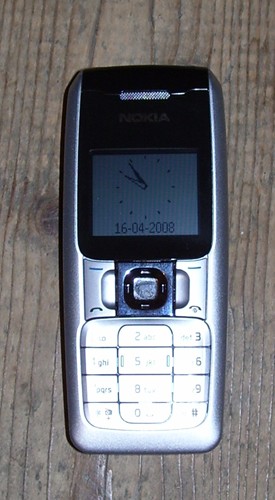
The Singing Librarian\'s new phoneWriting is not something that’s coming easily at the moment.   The final two assignments for my librarianship qualification are not progressing at all.  Quite a number of blog posts have been started but abandoned or deleted due to thoughts fizzling out half way through a paragraph.  Perhaps it is creativity in general that is lacking, as I am struggling to prepare a 5-minute children’s talk for church.

And so it is that I am reduced to a quite miserable blog post, illustrating a quite dramatic change in my life.  Last weekend I replaced my mobile phone.  This is hardly a novel event in the world.  Some people seem to change their phones every few weeks, but this is news indeed in the world of the Singing Librarian. My previous phone had served me well for at least seven years, possibly ten.  I only discovered last summer how to send texts in lower case, and it had never been a constant companion the way that these devices tend to be.  Yet it had become a part of me, a part that felt right despite the teasing about it being a ‘house brick’ and the fact that it quite genuinely was bigger than the cordless hand sets of my land line. It didn’t matter to me that the battery life was shockingly low, even though the battery seemed to weight a ton. It didn’t matter to me that if I wanted to send a text, I had to write the number down first. I suppose I was resisting conformity, going against the flow by owning a mobile phone that wasn’t truly mobile, certainly not in the summer, when pockets big enough to hold such a monster become impractical. Eventually, though, I cracked, and caused great amusement to a phone shop employee when he saw what I wanted to replace.  Great disapppointment as well, when I made it clear that I still wanted a basic telephone, not a camera plus mp3 player plus internet on the go plus food processor that happens to be able to make telephone calls.  I like simplicity, and that is what I got.

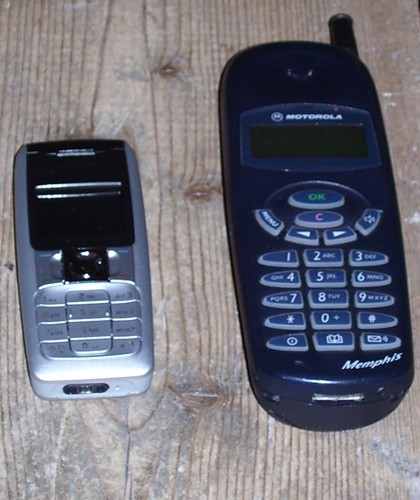
Old and new phones, side by sideReaders can see from the photo just how dramatic a change this is. From a giant beast to a slimline creature that fits happily inside a shirt pocket. From a black behemoth to a happy silver sylph. And yes, my readers would be quite right to suppose that the behemoth has an extendable aerial. I’m afraid it really could make a difference to signal quality sometimes.

The new phone is very novel to me at the moment, but in time, I will no doubt become accustomed to it. Still, it is, for me, a big change. In some ways, it feels like the loss of a part of my personality, a decision to go with the flow and do what everyone else is doing. But mostly it feels sensible and indefinably exciting, as my telephony finally enters the twenty-first century along with the rest of me.

As for the old phone, my faithful servant for all these years, I shall keep hold of it.  If I should ever do a show set around the turn of the millennium, it could be a useful prop.  Until then, I expect I can find a use for it as a paper weight or something equally practical.  Perhaps a door stop…

Talented youth


This week, I have been privileged to see talented young people performing in two different venues in Canterbury, and it has inspired and encouraged me.

The first was a performance of a musical by two of the local grammar schools – the Bernstein/Sondheim/Laurents masterpiece West Side Story.  I am not frequently in attendance at school shows, but this one starred a talented young guy who I have performed alongside in Kiss Me, Kate and My Fair Lady, and I wanted to support him, so turned up to the opening night along with a couple of other members of the operatic society.

From the overture onwards, I was frequently impressed by the skills, energy and enthusiasm of those involved.  The orchestra negotiated Leonard Bernstein’s difficult score very well, and seeing the show performed by people of around the right age for the characters was a rare treat.  Though there were some iffy moments, these were far outweighed by the good bits.  ‘Gee, Officer Krupke’ exploded with energy, and the boys were clearly loving every moment of that song.  The ‘Tonight’ quintet was impressive – not perfect, but very, very good.  It is an incredibly tricky piece of music.  In terms of stage craft, I was amazed at the ensemble’s ability to hold a freeze at the end of the ‘Somewhere’ sequence – it seemed as though not a muscle twitched.  The leads acted most of the adult characters off the stage.  My young friend had an entirely natural, relaxed and convincing air to his performance as Tony and both the main girls impressed me greatly.  The girl playing Anita had an incredible voice, with immense power and control far beyond her years.  I was so glad I had gone and I was encouraged that the schools were supporting talented young performers – involvement in a project of that nature can teach many things which cannot be taught in conventional lessons.

Then on Saturday, I was a steward at the semi-final of a talent competition run by the local churches for the city’s secondary schools and further education institutions.  This competition has many aims.  To encourage and develop local talent (the judges are from a local stage school and offer helpful advice as well as giving out scores).  To demonstrate that the church is not a remote and cold institution.  To have fun. 

The talents on show at the heats and the semi-final were diverse – dancers, singers of all varieties, solo musicians, bands, a comedienne and even a pair of roller-dancers.  Some are better than others, but most of them perform with such joy and enthusiasm that it is infectiously exciting, even if their particular brand of performance is not the spectator’s normal cup of tea.  Particular highlights from the semi-final include a girl who had written a song after hearing someone on the radio say they’d never been given flowers or a card on Valentine’s Day.  The song was well-structured and moving, and her delivery very engaging, using her deep voice to great advantage.  And then there was the boy who did an Irish dance routine, who was able to do amazing things with his knee joints.  It was also encouraging to see the acts cheering each other on and giving fulsome applause.  Next week’s final should be an absolute delight, though I fear the pressure of counting the votes may get to me!

It is a joy to see talented young people perform, perhaps even more so than talented people who have had time to refine their craft.  There is a raw energy and excitement to what they do which is wonderful to behold, and there can be a surprising amount of talent locked in the youngest of bodies.  I can only hope that their teachers, relatives and friends continue to encourage them to use and develop their gifts into adulthood and that young people (particularly boys, who seem to have more inhibitions than girls) continue to be brave enough to act, sing, dance and create music.  It is a privilege to have shared in what they do.

Behind the scenes on opening night


Canterbury Operatic Society’s production of My Fair Lady opened last night, to a very appreciative audience.  I thought I would offer my readers a (long!) glimpse behind the scenes – what was the day like for me, playing Freddy Eynsford-Hill?

The day involved: a bit of running around the High Street searching for those last minute items I so desperately needed (facial wipes for the destruction of make-up, micropore for the fixing of microphone wires to the neck, and a wide white ribbon to transform into an unravelled bow tie); making my ‘have a good show’ cards, which used quotes from my character with relevant pictures; phoning home to arrange my parents’ visit at the weekend; and a last flurry of panic before leaving for the theatre.  Have I got the right colour socks on?  Have I put everything I need in my bag?  Is my voice working properly?  Should I eat something?  Can I eat something?  Have I remembered to shave?  Where is my glasses case?  Have I done cards for everyone I wanted to do cards for?  Am I breathing?  And so on.

Finally, it is time to head out to the theatre.  I arrive a little before 6.30pm, and wander the corridors handing out my cards, crossing back and forth with a number of others carrying out the same mission.  The musical director gives out bookmarks to her soloists, the director hand makes cards, one of the maids distributes special boxes of sweets to the different dressing rooms.  Soon, though, the flurry of activity is over, and everyone drifts back to their own dressing rooms, or starts gathering bits and pieces from wardrobe or props.

Continue reading

Cold taxis – cutting edge comedy?


Most theatrical productions include moments which mean more to the performers than to the audience – lines or bits of business which, for whatever reason, acquired particular resonance during rehearsals or performance.  Sometimes it may be because someone was struggling with something, so it becomes a shared joy when a moment finally works.  Sometimes it’s a choreographic moment which is universally loved, so that the wings get crowded with cast and crew watching every night.  Sometimes there’s a funny rehearsal story attached to a particular line.  And at other times, there is no reason for it at all.

In My Fair Lady this week, it is my lot to deliver one of this production’s lines, a line which many in the company find extremely funny indeed, and yet none of us can work out why.  The line is this zinger:

Eliza, it’s getting awfully cold in that taxi.

Not exactly comedy gold.  My character, the perfectly useless Freddy Eynsford-Hill, is only in this scene in order to get Eliza off the stage and allow her father and the chorus to launch themselves into ‘Get Me to the Church On Time’.  It is dawn, so it would be rather cold, even in a taxi.  There are numerous ways I could say this line to make it funny, and I have experimented.  There’s the suggestive, the teeth-chattering, the whiny.  Rather than spoil the scene with any of these, we are going with a simple statement of fact, yet the first time we reached the scene in question with the whole cast present, it provoked chuckles, giggles, titters and outright laughter.

This has continued to be the case and as the dress rehearsal is in only a few more hours (that’s all the time we’ve got…), it is surely now a problem.  Nobody can put their finger on why the cast are amused, including the director and others in positions of authority.  The only explanation that has been forthcoming is from the lovely chap who plays Alfred Doolittle, who says it’s because it’s “just so good”, which really doesn’t explain things.  Unfortunately, he is on stage as I deliver that blasted line and struggles to maintain a straight face.

It may just be my imagination, but I’m sure the tension now mounts among the cast as that line approaches.  We know we can’t laugh and we know it’s not funny, but that makes it so much worse.  The last time we did  the scene, in the last full run-through (which you have to treat almost as a performance), even I was struggling to keep a straight face and I never, ever, corpse in performance, no matter how ridiculous the scene might be.

You can guarantee that the whole cast will remember that one line for years to come, while the rest of the lines, harmonies and dance steps fade away.  For a few dozen people, those few words will live forever.  All we have to do now is make it through one dress rehearsal and six performances without laughing at them.

Reviewing Rodgers – 1: Manhattan


The first big song hit for Richard Rodgers and Lorenz Hart was a ditty called ‘Manhattan’, which made a big splash when it was included in the first edition of the Garrick Gaieties in 1925, a revue which originated as a benefit performance for the Theatre Guild.  It had been written three years earlier for a musical called Winkle Town, but that particular show never saw the light of day so the song rested dormant until its big discovery.  It wasn’t Rodgers’ first song, not by a long way, since he had been publishing some of his work since 1917, but it was the song that made ‘Rodgers and Hart’ household names for the first time and launched them on to a series of hits over the next few years.  Everyone was singing it, and an incredible number of people have recorded it since – from Ella Fitzgerald, Tony Bennett and Dinah Washington to Anne Bancroft and Rod Stewart.  But what makes this song so special?

Well, firstly the music, which has a delightful bounce which is incredibly catchy.  It has an incredibly laid-back tune which captures the feel of strolling along without a care in the world and simply exudes joy.  Like many of Arthur Sullivan’s tunes, as well, it allows the lyric to be heard clearly, which is important as the words do not repeat other than in the last few words of each refrain (“We’ll turn Manhattan into an isle of joy!”).  It’s instantly recognisable from just a few notes of the refrain, which probably contributed to its initial hit status – catchy music spreads faster than a virus.

The lyrics, though, are what make the song for me, and yet I only recently realised how clever they are.  We tend to accept the song on face value, a pleasant little number about a courting couple enjoying spending time in New York rather than going off on an adventurous holiday.  But close attention to the lyrics tells a different story.  From the most familiar refrain (the first), we get the following lines:

It’s very fancy
On old Delancey
Street, you know.
The subway charms us so
When balmy breezes blow
To and fro.

What a charming image.  Or is it?  Balmy breezes on the subway?   They’re singing about the gusts of air that assault the platforms as the trains arrive and depart.  Breezes certainly, but not particularly balmy or at all pleasant.  Other highlights of their wanderings in Manhattan include a futile attempt to cross a busy road and eventual arrest.  And yet they seem quite content.  Is this a song that show us love can make the best of a bad thing, or is it a satirical swipe at the island of Manhattan?  Probably a little of both, with perhaps the emphasis on the latter. 

Whichever it is, Rodgers and Hart followed it in the next year’s Garrick Gaieties with ‘Mountain Greenery’, a song which expresses much the same notions about a countryside retreat, including the joys of collecting wood and encountering mosquitoes.  The pair seem to be having fun with the conventions of the love song – each song works beautifully as a romantic duet (or solo, which is how they tend to be recorded), while simultaneously poking fun at the locale in which the amorous couples are located.  As they sing, these lovers can turn even dirty, dangerous Manhattan into an “isle of joy”.  And Rodgers and Hart could turn this idea into a hit song which has survived for over eighty years.

The point


What is the purpose of an academic library?  Why do universities sink so much money into them, buildings and services which bring in little or no revenue and eat up staffing, equipment and stock resources at an alarming rate?  Why are they one of the key points in many students’ decision-making processes when they’re applying to university?  What are they supposed to achieve?

I specify academic library, because I believe the key functions of a library in a university are not necessarily very closely related to those of a public library, a school library or a private library in a large firm.  Each of these has a purpose and each involves vastly different challenges for the people who work for them and different levels of expectation from the people who use them.  The stakeholders, for want of a less ridiculous word, in an academic library are many and varied.  The students, of course, make extensive use of the library’s services, but even they have differing needs.  A first year undergraduate fresh out of school wants some things, but the desires of a doctoral researcher returning to higher education after decades in employment barely overlap with those.  Then there are those who teach the university’s subjects, the members of the local community who may or may not have access to the facilities and the university’s management who need the library in order to meet the objectives on their strategic plans and long-term policies.

But what is it there for?  An academic library should, I believe, be many things, but it should not just be a building where books and periodicals can be found on shelves, a repository.  Physical stock is very important, and access to information is clearly one of the defining features of a library.  But the information doesn’t necessarily have to be in printed form in row after row of shelves, much as I adore books.  Information exists in a near-endless variety of forms.  Audio-visual information on cassettes, CDs, DVDs and other media is increasingly vital for many subjects, and information stored electronically even more so.  In addition to the traditional printed word, the shelves and cupboards in my own library house CDs of classical and world music, video documentaries, language learning cassettes, films and operas on DVD, educational posters, CD-ROMs, maps and probably more that has slipped my mind.  All of these resources are needed by the students and all of them are an important part of what the library provides.

Libraries also provide access to a wealth of electronic resources these days, in the form of databases and repositories accessed via the internet and hidden behind a wall of passwords and usernames.  These electronic resources include collections of periodicals which can be read on-line, collections of archived sound, photography and video, interactive maps, backdated newspapers and electronic facsimiles of documents which no undergraduate student would normally get within a few yards of.  There is an increasing move towards providing electronic access to these resources, even when academic libraries could provide the physical alternative.  With ever-increasing student numbers, with many of these being part time or learners at a distance, it can be more efficient and cost effective to provide electronic access to something, allowing more users to view it than could be achieved with even two or three copies of a book.

But none of this is the key reason for an academic library’s existence, as far as I see it.  Libraries would be pretty useless if they didn’t provide students and staff with the books, articles, films and so on that they need, but there is a greater role in the value added by a library.  The skills, expertise and time of the staff.  Librarians are experts in the realm of information – how to find it, evaluate it, store it, use it and so on.  In public libraries, this is generally used to answer questions on behalf of the users, but in academic libraries, there is a greater emphasis on imparting these skills to students.  Through skills sessions, enquiries, casual encounters, documentation and tutorials, the library staff can, and should, provide another strand to the learning undertaken by the students in their university life.  Those on a history course should not simply learn about (and maybe even understand) history, they should learn how to search for relevant information effectively.  Students of film should learn how to track down particular works they wish to analyse.  Scientists should be taught how to keep on top of the most recent research on their subjects.  There is so much more to information-seeking than a quick Google search, a glance at imdb or a read of the New Scientist.  Google is good, but librarians can teach students how to use it to find more relevant and useful information, or they can point the way to a search tool that is specifically targetted to their subject area.

That is the point of a university library – to provide access to information and to provide students with the tools they need to find and use that information to best advantage.

Reviewing Rodgers – 0: The Beginning


A new series for the new year, stemming from an idea that has been percolating for some time. Richard Rodgers, famous as both …and Hart and …and Hammerstein, left behind a rich legacy of songs and shows, some of which endure, while others fade quietly away. My intention, at least once a month, is to focus on one aspect of his work at a time, including each of his eleven collaborations with Oscar Hammerstein II from Oklahoma! in 1943 to The Sound of Music in 1959. Individual songs, shows, films, themes, whatever seems apt or interesting and in no particular order.

Rodgers helped to redefine musical theatre with landmark shows such as On Your Toes, Pal Joey, Oklahoma! and Carousel, each of which contained innovations which pushed the genre in new directions. He also wrote the music for some of the most enduring songs of the twentieth century – ‘Blue Moon’, ‘My Funny Valentine’, ‘You’ll Never Walk Alone’, ‘Oh, What a Beautiful Morning’, ‘Have You Met Miss Jones?’ and dozens more. Perhaps most importantly, he’s a composer that I admire, with a body of work which I (mostly) enjoy very much, spanning some sixty years between his first and last published songs. He’s also a composer who is very much on my mind at present, as I immerse myself in his music prior to playing him on stage.  A love of Richard Rodgers may hardly be original (though perhaps slightly unusual in one who has not quite turned 30), but one thing I hope to demonstrate along the way is that he could be surprisingly unconventional, given that we now associate his most famous musicals with a sort of safe, middle-class theatricality.

And so this post is only a beginning, a signal that there is more to come. But the beginning is, as I’m sure we all know, a very good place to start.