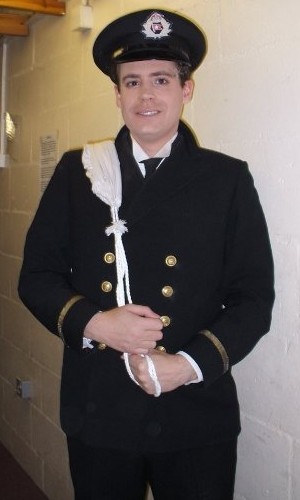
Rehearsals are odd: Cowpats, jugs and potential RSI


It occurred to me, while rehearsing for Titanic this week, that companies in rehearsal develop their own language to one extent or other, whether verbal or visual, such that strange sayings or actions go completely unremarked by all concerned, when an outsides would find them seriously bizarre.  Dance steps acquire strange names which surely aren’t in the standard choreographic dictionary, scenes get named after a small piece of business which happens in them, characters have their names shortened in quite disturbing ways and certain phrases will inspire fits of giggles for no easily discernible reason.  Just as a group of professionals will share their jargon and close friends will adopt the vocal tics of others in their circles, so the cast and crew of a show, who spend a lot of time in close proximity with a clear focus, develop their own forms of expression.

The reason this occurred to me was due to Titanic‘s cowpat.  Not, perhaps, as famous as the iceberg or the grand staircase, but a key element in our production nonetheless.  Readers will be relieved to learn that there are no animals in the show (unless one of the dogs that have occasionally turned up to rehearsals decides to play Kitty, Mr Astor’s airedale), and the cowpat is simply a piece of the set.  It is a ‘truck’ (movable bit of set on wheels) consisting of a raised platform shaped like half an octagon, but none of us have actually seen it yet, for the set doesn’t arrive until tomorrow.  This piece of set is right in the middle of the stage and gets used for all sorts of interesting things – the captain’s table in the first class dining saloon, the radio room, the place where the lifeboat will be lowered from and so forth – but at one point, the director found it to be frustrating and oddly-shaped, so it gained its name, which promptly stuck.  Anyone told that they are ‘up on the cowpat’ for a particular scene knows exactly what is meant.  It will be quite a letdown if it doesn’t actually resemble a cowpat in any way.

Another oddity is the use of a jug on stage.  Not as a jug, but as a megaphone, used when boarding the passengers and declaring the ship lost.  It goes utterly unremarked, and the shared visual language of the cast equates jug with megaphone.  I’m hoping that when we start the show proper, there will be a megaphone – audiences are less willing to enter into the shared world of the cast to quite that extent.

Finally, for me, the potential for repetitive strain injury is a little worrying.  During the second act, there is an extended musical scene between the Captain, the owner and the architect of the ship, which takes place in the radioman, with Harold Bride as a mostly silent witness to the proceedings.  During their arguments, the radioman is continually sending the distress call, alternating between the old CQD and the new SOS.  This is a lot of rapid wrist movement which quickly becomes tiring and painful – and this after just five or so minutes.  It is no wonder that typists and telegraphists frequently suffered from RSI.  In context, the least of Bride’s worries, but it is somewhat frustrating not to be able to stop and shake the joint out, as this would apparently be rather distracting!

The Singing Librarian’s Tour Diary


Readers of this blog will be well aware that the Singing Librarian normally has two or three projects on the go at any given time, so here is a brief update on where he can be seen and heard in the coming months:

12th-15th November 2008
Titanic
Marlowe Theatre, Canterbury

Playing the role of 2nd Wireless Operator Harold Bride in Maury Yeston and Peter Stone’s musical based on the fateful maiden voyage of RMS Titanic, “the largest moving object in the world”.  The show won five Tony awards when it debuted on Broadway in 1997 and has become a popular show with community theatres and local performing arts societies, in this case Herne Bay Operatic Society.  The role includes a beautiful duet, ‘The Proposal’/’The Night Was Alive’ and is musically challenging due to the complex (but very powerful) score.

22nd December 2008
Prepare the Way
The Ark, Dover

A Christmas oratorio by Phil Hornsey.  This is a fresh musical setting of familiar Biblical texts andwill be an enjoyable evening for both singers (mostly local to Dover, with one or two sneaking in from other parts of Kent) and audience.  For more information, see the page on Prepare the Way.

10th-14th March 2009
The Pirates of Penzance
Gulbenkian Theatre, Canterbury

Ageing up to play Major General Stanley in the very, very silly comic opera by Gilbert and Sullivan.  A different sort of challenge to the usual, including the famously tongue-twisting ‘I am the Very Model of a Modern Major General’.  This will be Canterbury Operatic Society’s fourth production of Pirates, but this is a show that stays fresh over the decades due to the deliberately preposterous plot and outlandish characters which can be mined for a rich vein of comedy.

That seems like quite enough for one Singing Librarian for now.  Mark some (or even all!) of the dates in your diary if you want to see whether librarians really can sing, and watch this space for future updates and a return to the regularly scheduled rambling, ranting and musing.

A musical mystery – Edwin Drood


This weekend, I saw a most fascinating musical in a theatre which can only be described as quaint. The Theatre Royal, Margate, is a beautiful building, which feels like a proper old theatre, with a balcony, boxes, pillars and intricate decoration adorning many of the available surfaces. The curtain is a deep red and both stage and auditorium are raked, which tends to equal excellent sight-lines for all (although according to one cast member it also leads to muscular pains and cramps for the performers who have to walk and dance on a strange angle).

The musical itself was The Mystery of Edwin Drood, based on Dickens’ last, unfinished, work. Creating a musical based on a story without an ending is obviously a challenge, and Rupert Holmes (who wrote book, music and lyrics) came up with an ingenious solution – let the audience decide. As soon as proceedings reach the point where Dickens “laid down his pen for the final time”, the actors stop the story and the rest of the evening is up to the audience. They have to vote on the identity of a detective in disguise, work out who killed the title character and, in order to furnish a good old happy ending, create a pair of lovers (the latter choice being entirely the result of audience whim, as there is no real evidence for any pairing, whereas you can just about manage to invent a justification in the text for most of the potential detectives and murderers). As this was an amateur production, though, the choices were largely dictated by which characters had the most friends in the audience for any given performance.

Presented in a music hall style, there are moments when the audience is encouraged (nay, practically forced) too boo the villain and join in with one of the songs. It takes a while for the audience to warm up to this, or at least it took us a while, but it does mean that the audience participation in the choice of ending was a more organic part of the show, feeling strangely normal by that point. The music hall style also allowed for a few songs which had nothing whatsoever to do with the Dickensian plot, by presenting it as a performance by a successful music hall company. The staging of this production reinforced this, with each principal performer taking a bow when introduced, then returning to the exact stance they were in moments before, which was often very funny. It also allows for overplaying, scripted diva tantrums and deliberately bad accents. All of which could be irritating, but work in context. The style of the piece and performance were enhanced by the theatre, which is old enough to have been host to the sort of music hall we were experiencing and still maintained the ornamentation and friendliness that one would expect of such a place.

The songs are not going to become favourites of mine, even if I spend the £40 or more that a second-hand copy of the original cast recording would require in order to hear them repeatedly – it has gone out of print (both the ‘complete’ version, with all the different endings, and the reduced version) and is a relatively sought-after collectors item in certain circles. I was quite taken with ‘Don’t Quite While You’re Ahead’ (irritatingly catchy) and the patter song ‘Both Sides of the Coin’, as well as being impressed by the writing and performance of ‘No Good Can Come From Bad’, a piece which involves most of the principals at Christmas dinner, showing the various tensions and undercurrents which may or may not be responsible for the death or disappearance of Edwin Drood.

The production benefited from strong direction and musical direction, with an impressive orchestra which was of higher than normal quality for a non-professional production. The performers ranged from adequate to very good, with no horribly embarrassing performances (and believe me, I’ve seen plenty of those, both professional and amateur). The Chairman of the Music Hall Royale was portrayed by a professional, but the rest of the cast was composed of local people, most of them being completely unknown to me. I was mostly impressed by members of the supporting cast. I had gone largely in order to see one of my friends perform the role of Neville, and he did not disappoint. I also enjoyed the performances offered by the lady playing Princess Puffer, and the gentlemen in the role of the Reverend Crisparkle and Durdles. Jasper, the most-booed villain of the piece, did not really do it for me, not being quite nasty enough for my liking. Drood herself (yes, herself) was excellent in terms of acting and moving, but weaker vocally in the slower numbers. The character of Rosa annoyed me as a typically wet Dickensian love interest, so I probably did not give the actress portraying her a chance to impress me.

The lighting was effective, including liberal use of the oft-neglected footlights, and the set was a simple affair of three movable screens. The production was, however, let down by the sound. Many of the singers disappeared behind the orchestra, making me wonder whether their radio mics were at all effective or whether they simply were not singing strongly enough for the mics to pick up since all the technology can do is enhance what it is given. It was frustrating to have to strain to work out what our chosen detective and murderer were singing about, particularly when other soloists had been perfectly audible earlier on in proceedings. Sound is a very difficult thing to get right (I also had major issues with the sound in a production of Gypsy two days earlier) and is not something I have any skill with, but it is extraordinarily important to the experience of seeing a show.

It was a most enjoyable evening, and I would recommend catching any performance of the show which may crop up. It is certainly unusual, but the concept and script offer a lot of fun. I was even heard to laugh out loud several times, which has to be a good thing. The production was not perfect by any means (note that I have not mentioned choreography…), but it was a strong one with creditable performances. The Mystery of Edwin Drood is well worth investigating.

A little joy


One of the problems of this interactive, interconnected web 2.0 world is that sometimes the collective wisdom of the social networks, blogs and wikis turns round and bites you on the bottom.  A case in point is a little application on Facebook called ‘Compare People’, which allows its users to compare their friends – Who has the best hair?  Who would make the best father?  Who was is the most naturally talented? – and be compared to their friends’ friends.  From time to time, it sends out a little e-mail telling you that Carlos and Petunia are your most dateable single friends and that you are less famous than 27 of your network of colleagues, relatives, internet weirdos and people you perform with.  As I have observed these friendly little missives over time, I have noticed that as my Facebook social network changes and evolves, my friends remain remarkably consistent about my strongest strengths and weakest weaknesses.  My top 2 strengths never change, being punctuality and reliability.  A little dull, I suppose, but a reasonably accurate assessment.  The weaknesses are a little more variable, but there one of them has been consistent for many months: happiest.  That’s right – every time someone compares me to one of their other friends and selects who they think is the happiest, they choose the other person.  I am apparently the gloomiest, or at least the least sunny, person I know.

This, oddly, is not something that increases my happiness, so perhaps this little piece of information has become self-fulfilling.  It worries me somewhat, for a few reasons.  As a person who suffers from bouts of clinical depression, what does it say about me when I am the least happy person even when not afflicted?  As someone who works in a service environment, what effect am I having on the students I work with?  As a Christian, shouldn’t joy be evident in me, since that is one of the fruits of the spirit according to the letters in the New Testament?  Come to think of it, I’m probably falling short on some of the others.  Love, joy, peace, patience, kindness, goodness, faithfulness, gentleness, self-control.  Are those really words that describe the Singing Librarian?  And so a tailspin of spiritual confusion begins.

The truth is that I’m probably happier than people seem to realise.  I am, oddly, quite capable of being happy without smiling broadly or laughing all the time.  I don’t tend to be ‘big’ about any emotions I’m feeling, and happiness is no exception.  I don’t shout and punch people when angry, I make sure that I cry in solitude rather than in public, and I don’t often grin from ear to ear.  Also, in recent months, I’ve probably been happier than I have been for quite a while.  West Side Story gave me an immense amount of pleasure (thanks, Phoenix Performing Arts!), and a not-so-little thing called romance has taken me by happy surprise as well.  Perhaps I don’t express my happiness as often as I should, but I am happy.  I may experience frustrations or the black dog may hang around from time to time, but in my own quiet way, I’m a happy singing librarian.

On this theme, I have been entertained and challenged recently by a song called ‘Spread a Little Joy’ by Andrew Lippa.  It talks (or sings) of how we can change the world by being infectiously joyous (not a new idea, as I can think of other songs along the same lines from many decades past) rather than infectiously gloomy.

Don’t spend your life rehearsing every whimper and whine.
Go and spread a little joy
Every girl and every boy.
When you spread a little joy,
Then the sun will shine!

Perhaps that should be a challenge for me.  Spread a little bit of joy somehow.  If it’s true that the world laughs with you, does it smile and get a spring in its step with you as well?  I don’t know, but it’s worth trying.  I have no idea how, but I resolve to spread a little joy.

Singing Librarian flashback: Trying to make an entrance


In most shows, every performer will make at least one entrance, unless they are on stage when the lights go up and remain there until they are no longer required, which would be a sad state of affairs.  It may be as part of a group, or as an individual.  It may be unobtrusive or it may be spectacular.  It may be from the wings or it may be from above or below the stage.  Sometimes, and perhaps trickiest of all, it can be from the auditorium itself.

It can be a strange feeling as an audience member when your safe, comfortable area on the other side of the footlights is invaded by a show’s characters.  It can be just as strange for the performers, entering into a strange limbo area that both is and is not part of the world you inhabit on stage.  For me, this has been part of the routine in four shows (that I remember, anyway): Grease, Kiss Me, Kate, Rodgers With an H and most recently West Side Story.  In Grease, the two gangs made their first entrance zooming down through the school hall’s central aisle and singing the rude version of Rydell High’s school song.  In Rodgers With an H, logistics meant that occasional entrances and exits had to be through the auditorium to avoid colliding with other performers, though this was a very short distance, so didn’t really matter all that much.  Kiss Me, Kate involved slightly longer in the auditorium, as I appeared there at the beginning of ‘Cantiamo D’amore’, singing rather high notes very loudly in a ridiculous costume before joining the rest of the chorus on stage. All three presented their own challenges of various kinds, but it is the most recent example, West Side Story, that is the most interesting.

Regular readers may recall that I played, somewhat improbably, both Officer Krupke and Doc in a production of the show in August.  In addition to the joys of changing costume and make-up (as well as voice, stance and so forth) between characters, the staging of the show presented fun and games in the second act.  At this point in the plot, the main characters have been scattered following the disastrous rumble which kills off two of the key players in the tragedy.  A-rab and Baby John, members of the Jets, encounter one another in the streets and share some of their anxieties before they are rudely interrupted by the arrival of rubbish policeman Officer Krupke, who wants to see them ‘hauled down to the station house’.  This entrance was made by crashing through one of the sets of auditorium doors about 20 rows back from the stage.  A blow on Krupke’s trusty police whistle and a yell, and I then had to lumber down to the stage ready for a brief scene threatening the boys.  Before long, they turn the tables, cause him to tumble and scarper.  A little bit of comic peering around, and I then had to repeat my entrance in reverse, lumbering back up through the auditorium and out through the doors.  Then I had to race down through the foyer and bar, punch in an access code to the dressing rooms, race along the corridor to my own and change into Doc as quickly as a jolly quick thing, but that’s another story. 

By now, you may be wondering what the point of this tale is, anyway.  Other than the possibility of falling down the steps in the dark, or treading on an usher, which I very nearly did, what challenges could this entrance possibly present?  It is worth noting that this is one of my favourite ever entrances due to its high impact value, but it was actually the moments before the entrance which caused difficulty, and largely due to factors beyond my control.

The trickiest thing about making an entrance through the auditorium is timing, as it would spoil the illusion to betray your presence too soon.  And timing depends on being able to hear the action on stage, which is not always easy through a thick door.  Noise on your side of the door is therefore not particularly helpful.  Distant sounds of activity from the box office can be screened out, but other interventions are harder to deal with.  And other interventions there were, from someone who should have known better and from a member of the paying public.

The first was from the person who should have known better.  As I approached the door to the auditorium for one performance, it opened and out came an usher, who began to speak into her mobile phone before the door had fully closed behind her, organising her shopping trip for the next day.  She didn’t move very far from the doorway, and seemed utterly unconcerned about the presence of a young chap in a hot and heavy police uniform complete with truncheon and whistle.  Even after drawing the curtains around the door area which prevent light from leaking in, it was still a struggle to hear the Jet boys over the travails of her socioeconomic life.  I don’t know how long it took her to work out which shop was the best meeting place, and whether they should have a coffee first, but these important decisions must have been made at some point between my dramatic entrance and dramatic exit.  Now, never having been employed as an usher, I can’t be sure of these things, but…  Surely…  Surely, a job which requires you to be present in the auditorium at a live performance is a job where your mobile really ought to be switched off?

A couple of performances later in the run, and another effort was made to sabotage the entrance, but this time from a member of the paying public, who can be granted some leeway for having been kind enough to part with some hard-earned cash to watch the show.  On this particular occasion, I was in position a little earlier than normal.  As I waited for the action on stage to approach my entrance point, a gentleman appeared from the foyer area, having evidently felt the need to spend a penny or two.  He stopped in mild confusion when he saw me and asked whether I was about to go on.  Why, yes, I was.  I did have to wonder what else he thought I’d be doing in the corridor.  Was I listening, he asked.  Yes, I was.  He kindly volunteered to wait until my entrance to regain his seat, and I duly thanked him as I pressed my ear to the door, knowing that my cue was coming up, grasping my truncheon and positioning my whistle in my mouth.  There was a brief period of silence in the corridor, as the dialogue approached the crucial juncture, then he spoke again with astonishing insight, though a definite lack of good timing.  “It must be very difficult standing out here trying to hear what they’re saying.  Do you have to –”  Sadly, I don’t know what it was I may have had to do, as A-rab gave my cue line just as my new friend made his own speech.  Do I have to deal with many people talking when I’m trying to listen to something else?  Do I have to struggle to get into character when surrounded by heavy blue curtains?  Do I have to train hard to look quite so ridiculous in a uniform?  Tempting though it may have been to answer whatever question he wanted to pose, there was only one course of action that I really could follow.  As ever, I burst through the door, whistle blowing, and entered the scene.  However, I couldn’t help but reflect upon how easily everything could have been disrailed.  A loss of focus, concentration and character could so easily have followed, and certainly would have done if the lovely man had succeeded in drawing me into conversation.

Sometimes, making an entrance can be complicated by the most unexpected things – people.  But what would an actor do without them?

Quirky, but unspectacular


The writer of Book Calendar, a blog about books (among other things) from an American librarian and keen reader, tagged me with one of those memes which encourages bloggers to reveal random facts about themselves to the world.  So, first the rules of the meme, and then the results chez Singing Librarian.

1. Link to the person who tagged you.
2. Mention the rules.
3. Tell six unspectacular quirks of yours.
4. Tag six bloggers by linking.
5. Leave a comment for each blogger.
6. There is no sixth rule, but I feel there really should be.

So.  Unspectacular quirks.  That’s an interesting one, as I tend to think of quirks as being fairly remarkable things, but remarkable does not necessarily equal spectacular.  I also need to make sure that I haven’t mentioned them before, as that would break the spirit, though not the letter, of the meme.

1 – Although I really don’t like tomatoes (or tomato sauce, or tomato soup or even Heinz baked beans), I am very fond of pizza.  Chicken, or pepperoni, or mixed meat, or ham and pineapple, or even vegetarian, pizza is great as long as it doesn’t have actual slices of tomato on it.  I’m told that the vile fruit contains some important nutritional thingummies, so I even feel vaguely virtuous when I eat it.

2 – I can survive quite happily in a messy office or bedroom, but there are certain things that just have to be tidy.  CDs for instance.  My cast recordings are arranged alphabetically by composer, then by show, then (if necessarily) chronologically by recording date for multiple recordings of the same show.  Releases by individual artists are filed alphabetically and classical recordings are arranged by composer.  Sometimes Sir Arthur Sullivan causes a minor problem as I try to define a line between classical and musical theatre, but otherwise my mind feels much happier with everything in the correct order.  I even rearrange CDs in shops if somebody has carelessly put something back in the wrong place.  It is important, though I have no idea why, when my general environment is approaching a state of entropy.

3 – I hate being late for anything, and have been known to make my watch run a few minutes fast in order to avoid this possibility.  Work, church, rehearsals, parties, it really doesn’t matter.  I will arrive early, and if necessary take a walk or three around the block until the appointed hour has truly arrived.  I am gradually managing to acclimatise to lateness, though, and will no doubt become spectacularly unreliable in a decade or two.

4 – My general male inability to remember what clothes people may have worn recently is quite pronounced.  A few days ago, I was wandering through the supermarket and realised that I had no idea what colour shirt I might have been wearing, as it was hiding underneath a jacket.  I don’t think this was a typical senior moment, just a demonstration of just how little impact clothes make on me.

5 – On stage, my most notable quirk is that I’m not a fan of either curtain calls or follow spots, which are often beloved by most performers, whether amateur or professional.  I find both of them rather embarrassing, perhaps because they are impossible to explain within the world of the show.  Singing and dancing can, if you accept the conventions, flow from heightened emotions, but follows spots really can’t.  I was very pleased that my ‘Soliloquy’ performance lacked a follow-spot – the lighting man and the director decided that it would ruin the song, which it certainly would have done.  Curtain calls are also odd things, particularly if a solo bow is called for – I always feel awkward, as it feels as though I am rudely demanding applause from the audience.  And yet, as an audience member, I generally appreciate the chance to clap my favourite performers loudly, and even give a cheer if I am particularly excited.  Double standards…

6 – I am far too indecisive.  It has taken me a very long time to post this because I could not decide what to put as my sixth unspectacular quirk, so in the end I decided that indecision itself had to go here.  Some people could argue that my inability to make a decision is actually a rather spectacular quirk, and I will indeed sometimes go out of my way to avoid making a choice.  I’m not talking about the really big decisions in life, though they don’t come easily.  I’m talking about the little ones.  Which book to read next, or what to have to drink.  Even whether to have anything to drink at all.  These things can bring me to a dead halt as my brain refuses to work with me, so a meal out can be a strange form of torture to my soul, albeit one that has a delicious aftertaste.

So there you have it, six quirks which may or may not be unspectacular.  Now for the tagging.

1 – Aphra, because even if the quirks are already known to readers of her blog, her explanations will be highly readable.  ‘Danger of eclectic shock’ is her tagline, and readers can certainly expect eclecticism.

2 – Helen.  I always enjoy reading her blog, but don’t comment as much as I should.  Musings here are generally concerned either with the act of writing or the actions of young Kiko, who I feel I know better than I know any toddlers that I actually encounter in everyday life.  Kiko certainly has quirks (in a good way!), so I can’t help wondering what Helen’s may be.

3 – mrspao.  I suspect that some, if not all, quirks could well be connected with either cats or knitting, but I’m interested regardless of whether this prediction is true. I should confess that I know mrspao in real life and knew her in a non-internet context before an internet one.

4 – Reed, who is one of the most articulate, amusing, readable writers I’ve encountered. Her writings are often on the subject of writing, and although I know she hasn’t blogged recently due to the perils of work/study/life balance, I’d love to see her do so again. With no obligation, of course. Feel free, Reed (and anyone else) to ignore my tagging. I’ve ignored a meme or to in my time.

5 – Music Man. Another currently silent blog, belonging to a fellow amateur thespian, though one further North than I.

6 – You, if you feel that you wish to share six unspectacular quirks with your readership.  I’m certainly interested (or is that nosy?) enough to read what you might like to write…

An anniversary


Today marked the 8th anniversary of my arrival at the Library of Doom, a nervous young graduate entering his first full-time job, as a humble Library Assistant.  I seem to recall that the day was sunny, and three ladies started at the same time as me, though none of them work here any longer.  I had been staying with two friends, who had generously opened their home to me while I searched for somewhere to set up camp.  I live with them again now, as we have purchased a house along with another friend, but in the intervening years I had four other addresses which were not also theirs.

In that time, I have moved from Library Assistant to Senior Library Assistant, with a four-month diversion when I was seconded into an Assistant Librarian position.  I have seen many members of staff come and go, watched students start and end PhD theses and become academic staff members, seen several new libraries start up, processed many thousands of inter-library loans and watched far too many ducklings grow up in our enclosed garden.  I have seen floods, leaks, power cuts, falling shelves and masonry, escaped animals, fire drills, injuries, potential law suits and deeply unpleasant bookmarks.  I have laughed, I have worked hard, I have lost motivation and found it again and I have, on more than one occasion, cried.

I have had to fill in only one medical self-certification form, for two days off work due to head trauma.  I had walked into a lamp post.  I have completed an MA in Literature and a Postgraduate Diploma in Information and Library Studies.  Outside of work, I have performed in eleven fully-staged shows and too many concerts to count, both classical and popular, with a slowly growing fan club of fellow library dwellers, alongside assorted others.

So what did I do at work today, to celebrate such an anniversary?  I attended a development workshop where one of the tasks involved writing a story about being a member of staff at the University of Doom in 2014.  I sat on a help point for two hours and helped only one person.  And I peeled stickers off books as part of transferring them from short loan back to the main collection.  All in all, a thrilling day!

Stock editing


Sometimes, every library has to do something which does not come easily to its staff – get rid of some precious, precious books.  Sometimes they are sold, and librarians witness the strange spectacle of people fighting to pay for a book which nobody has wanted to borrow without charge for several years.  Sometimes they get traded to another library or donated to schools or literacy campaigns.  Sometimes the books are of no use to anyone and simply get recycled.

The Library of Doom has a space crisis on its hands (if libraries can be thought of as having hands), and has had this for quite some time, as I’ve mentioned before.  We don’t have enough room for all the books currently in the collection, which makes it quite interesting trying to add new acquisitions to stock.  In an academic library environment, there can be considerable resistance (generally from outside the library) to removing anything from stock, but it simply has to be done on a larger scale than usual.  This process is known as ‘stock editing’, mostly because terms such as ‘weeding’ and ‘withdrawals’ are seen as negative.  So why should items be edited out of library stock?  None of these can be hard and fast rules, as there will always be exceptions and special cases (I wouldn’t ever want to dispose of a holy book from any religion, for instance – it would seem disrespectful), but here are three key factors which justify editing.

1 – Condition

The easiest way to justify removing an item from the shelves is that it is falling apart.  Bibliographic Services teams in libraries can work wonders on poorly books, transforming them with their array of exciting tools and a bewildering variety of sticky substances, but sometimes the effort is not worth it and that book has to go.  This is even easier with audiovisual material – if a video has been exposed to an electromagnet, or if a DVD has been placed on the record player, there’s little that can be done to save it.  Of course, if items get into a disreputable state, they’re probably being used a lot, so a replacement may well have to be ordered.

2 – Obsolescence

Books become obsolete at different rates.  Certain subjects taught at the university are particularly prone to this – law and health, for instance.  In these subject areas, stock editing is already fairly rigorous, as you don’t want students learning out of date clinical care practices or working on the basis of laws which have altered.  The government frequently changes its mind about social welfare or the educational curriculum, which means that practical books from these subject areas can unexpectedly become obsolete.

Even in less obvious areas, new editions of books are brought out, superseding older ones.  Sometimes there is value in a chapter which only exists an old edition, but it is only worth keeping one copy, rather than a dozen or so, which take up half a shelf between them.  In these modern 2.0 times, print resources can arguably be superseded by electronic equivalents from time to time, particularly for key reference works such as the Grove Dictionaries of Art and Music.

Related to this are those books which have not had a more recent edition published or have no obvious successor, but are still misleading, inaccurate or out of date.  Material on teaching genetics in schools which was published in the 1970s, for instance, though these are quite intriguing if only for the jumpers worn by the children on the covers.

3 – Relevance

Books in some areas never really become obsolete, most notably in the arts and humanities, where new ideas and new interpretations are often seen as alternatives to older theories rather than as new truths.  However, this does not mean that collections of material concerning music, literature, history or theology could never require ‘editing’ in an academic library, as they can become irrelevant without becoming obsolete.

For instance, there may be an academic who has a particular interest in the Victorian novel and teaches a number of modules on the subject.  If he or she were to leave the university, their successor could well be a specialist on eighteenth-century poetry or on literary censorship.  It is likely that such major figures as Dickens, Hardy, Eliot and perhaps Wilkie Collins may continue to be studied, but material relating to minor figures such as George MacDonald (one of my favourites) or Charlotte Mary Yonge will become irrelevant.  Students are not studying their work any longer, so shelves of books concerning them may go unused for years, taking up space which would be better served by increasing the library’s provision of material on, for instance, eighteenth-century poetry.

Modules and entire degree courses come to an end surprisingly often as a result of political or economic factors, and this can be a major cause of academic libraries filling up with irrelevant stock.  If we no longer teach agriculture, why should we have more than a very basic collection on the subject?  If the music department now concentrates on the classical period, do we need thousands of volumes examining the baroque composers?  I think not.

With exceptions such as major research institutions or legal deposit libraries, an academic library should always be a useful, relevant, living resource.  As Charles Cutter, an influential American librarian, said in 1901, “The library should be a practical thing to be used, not an ideal to be admired.”  It’s been over 100 years since he expressed this sentiment, and it’s more true than ever.  Libraries are often seen as outmoded institutions with little to offer in our networked world.  Careful editing of stock can be part of the process of challenging this perception by ensuring that users find the material that they need and want without having to wade through a sea of dust emanating from shelves of books which haven’t been out for a decade or two.  I think that’s worth the effort, personally.

Pub quiz of doom


Quizzes are, in my opinion, a very pleasant way to spend an evening, particularly if you do so alongside nice people.  There is exercise for the brain, there is pleasant company, there is camaraderie, rivalry and a soupcon of tension.  There can be banter, lively debates about the correct responses, moments of amused frustration when the right answers are revealed and even a thrilling tie-breaker.  So, in company with four lovely people and a slightly bewildered guide dog, I was looking forward to a good evening as we descended upon the Olde Beverlie pub.  The event turned out to be highly amusing, but not really for the expected reasons.

The team was merrily chortling, and even weeping with laughter, very early on in proceedings as the quizmaster announced the rounds, so that we could choose where to play our joker.  “Round 1,” he told us “is General Knowledge 1.”  Fair enough, most quizzes could do with a round or two of general knowledge questions.  “Round 2 is General Knowledge 2.”  OK…  Perhaps it would have been better to mix the rounds up a bit, but we can cope.  “Round 3 is… General Knowledge 3.”  Oh, dear.  By this point, murmurs were going around the venue and it was with a sense of great anticipation that we awaited news of round 4.  Sure enough, General Knowledge 4.  “Are you sure?” shouted one team as our table slowly lost control and displayed varying levels of mirth.  Undeterred, we were informed that the next round, predictably, would be General Knowledge 5.  Thankfully, round 6 would be a specialist round, where the joker could not be played.  But round 7 would be… General Knowledge 7, of course.  Though surely it should have been General Knowledge 6 as there was a definite lack of that number?  No, 7 it was and would remain.  Then there’d be General Knowledge 8 and the Who/What/Where Am I round, just for a touch of variety.  “So you’ll be playing your jokers blind.”  No kidding.

At this point, I should mention that not only did the quizmaster have the most boring voice imaginable (frankly, I’ve heard more interesting voices emanating from the software that reads scanned books aloud) and microphone technique that belonged in a wedding scene from a second rate romantic comedy.  Nobody had ever told him that microphones and speakers are not very good friends, so the entire evening had a soundtrack of squeaks, whistles and groans from the sound system, sometimes varied by the quizmaster whistling into his mic. – not an activity that is likely to win you many friends.

Having had Mr Deadpan and his Public Address Orchestra tell us the names of the rounds, we paused while team names and monies were collected.  Our table agreed that the laughter brought on by being told that “Round 8 is General Knowledge 8” was worth the one pound admission fee in itself.  This was just as well, for the evening had truly peaked at this point, though the team that aptly named itself ‘Generally Knowledgeable’ certainly made a bid for Mr Deadpan’s comedy crown.

Questions were read in a barely comprehensible fashion, partly due to the ever-present feedback and partly due to the quizmaster’s accent, which grew thicker and thicker as more alcohol was consumed.  They followed relentlessly one after the other, with no breaks between rounds until the half way point of marking and collecting scores, which was probably demanded by the barman so that the quizzers could have a chance to buy some refreshing beverages.

Because our quizmaster is a natural comedian, he would sometimes tell us the wrong answer to a question, then say, with barely a moment’s pause “just kidding, it’s…”  There are times when this could be funny, but when you’re mumbling into a badly-used microphone and displaying signs of inebriation, it’s just annoying.  Comic timing is not a skill that appears to be necessary to host a quiz.  To be fair to the man, he did appeal for someone else to organise a future quiz or two to give him a rest, but he really was the worst quiz host I’ve ever encountered.  The event had amusement value, but largely from cringing in horror at his extraordinarily politically incorrect comments or growing ever more frustrated with his microphone technique.  It’s not a pub quiz I’m likely to attend again.  Consider this an official unrecommendation.

If you do go, they’ll probably have reached General Knowledge 74…

[UPDATE: For a different, more amusing, view on the same event, see Lyndall’s post Publicly Quizzical.]

Something new every day


They say that you learn something new every day. This is probably true, even if it’s only something that’s seen, read or heard in the news, but I suspect we all forget many old things each day. I sometimes wonder whether new things push specific old things out of the memory banks and whether the volume of lyrics, tunes and useless facts about musicals stored in my head will one day have a disastrous effect, as something vital such as ‘alphabetical order’ or ‘how to breathe’ falls out of my ears as yet another song goes in. Recently, in addition to everything I’ve been learning for my various performing exploits, I have learned some more unusual things, which I thought I’d share.

1 – Bad posture can have painful results.On Monday, I woke up and my neck was very cross with me. The muscles in the right hand side of it were tight and angry, meaning that I could not fully turn my head to the left, and would get twinges of sharp pain when moving suddenly or when lying down. This was probably Officer Krupke’s responsibility, as it was noted in Sunday’s rehearsal that my Krupke posture was not going to do my back and neck any favours due to the way I was holding my shoulders. Or alternatively, I may have jarred the muscles when rehearsing the scene where Krupke falls over one of the Jets. Either way, a change of Krupke posture and some appropriate gentle stretching exercises gradually righted the problem. My advice – be careful, bad posture hurts!

2 – I cannot do an Irish accent. I really can’t. Monday evening was the first script read-through of Titanic, and one of the people that was missing was the young chap who plays Jim Farrell, third class passenger on the voyage. I was asked to read in for him and although his first line was delivered in a passably Irish manner, things simply went downhill from there until you’d have been hard-pressed to tell that the poor chap was human, let alone Irish. On the positive side, it did cause minor amusement to my fellow cast members, which was increased at the nadir of my accent attempts, when a particularly atrocious sound gave me a case of the giggles and caused me to go bright red as I struggled for air. I shall stick to the various English, Scots and American accents that I actually can do in future.

3 – The sense of smell can be numbed. On Tuesday, I helped at a family fun day organised by the local churches, where I spent the best part of four hours either serving or cooking sausages which were handed out free to grateful members of the public. I love sausages, but being part of the cooking and serving of several thousand sausages may have curbed my enthusiasm slightly. After only half an hour or so, I realised that I could no longer smell the sausages that were merrily cooking on the BBQ. My nose must have had enough and simply given up.

4 – An empty glove is not a good thing to be.The wonderful Archbishop of York was a part of Tuesday’s event and gave a great message about what it means to be a Christian. He compared life without God to being a glove without a hand in it – floppy and directionless. But being filled by God is like a glove is like a glove being filled by a hand, now able to wave, shake hands, bake a cake or do the hand jive (OK, so the Archbishop didn’t actually mention doing the hand jive, but you get the idea). He was speaking of Jesus’ statement that He came so that we could have life in all its fullness, not just a little bit of life, but an awful lot of Life. It was a clear, direct and inspirational message.

5 – One of my defining qualities is agelessness. It tends to be said that I look younger than I am, and I thought the cast of West Side Story were going to prove this when one of them guessed my age as 24. Unfortunately, yesterday, one of them (who is 13 but has the cheek to look at least 16) decided to guess my age and came up with the figure of 35. Yikes. I’m 29, and will turn 30 the day before the curtain rises for our production of Titanic. There’s nothing wrong with being 35, but really… However, to a 13-year-old, surely anything past about 21 is ‘ancient’.

6 – I’m a big softie. I don’t cry at films or books, and the only things I’ve seen in the theatre that I recall making my cry are Cabaret and Blood Brothers (though Parade and Billy Elliotmust both have been close to bringing on the waterworks). However, on Friday, we reached the final scene of West Side Story in a run-through, and there I was with tears trickling down my cheeks, so that I had to nip outside and dry my eyes before we set the bows. The last couple of scenes are deeply emotional for my more serious character, Doc, but even so… I don’t normally get deeply invested in my characters and this was a run-through in a hot room in a school, with very few costumes, with a few stops and starts and with only plastic chairs as the set, so I don’t know why it got to me. It did, though, so the only conclusion must be that I’m a big softie. I’m hoping that I get over this by the time we open on Wednesday, but who knows. Perhaps I’ll be a blubbering mess all week.

So there we have it. Six things that I’ve discovered this week. What’s your ‘something new’ for the day?