Archive for the ‘ Plays ’ Category

As strange to us as if they had never lived


In December, I had the wonderful good fortune to play Ebenezer Scrooge in an adaptation of A Christmas Carol produced by new local theatre company Constant Lark. This was a joyous experience, and a wonderful character to explore. Although his name has entered the language as a synonym for miserliness, the true wonder of Scrooge is how he learns and grows over the course of the story. He is, in many ways, both protagonist and antagonist – we follow his growth, but experience all of the worst he has to offer and the harm he has done to those around him, and ultimately to himself.

Snow falls against a bright red background. Between the snow and the background is a silhouette of a man in a nightcap. Text - Constant Lark, A Christmas Carol by Charles Dickens. A new adaptation by Brendan Roberts.
Constant Lark’s A Christmas Carol.

This is the second production I have done with Constant Lark, having played Prospero and Gonzalo in their debut performance of Shakespeare’s The Tempest (my first Shakespeare). They have a mission to bring theatre to new audiences, inspire a new generation and bring both classic works and new writing into the light. All good stuff as far as I’m concerned.

In A Christmas Carol, I had the strange experience of spending most of the time either pretending that I couldn’t see or hear my fellow performers (when they were narrators) or having them pretend they couldn’t see or hear me (when they were characters the Spirits were showing me). An unusual acting challenge for us all, I think, and I was so impressed with how everyone else stepped in and out of narrators and an array of beautifully drawn Dickensian people.

There were many scenes which resonated with me, but one in particular which I wanted to write about. During the section about Christmas Present, I/Scrooge argued with the Spirit. The scene featured baker’s shops, where (as I understand it) poorer people would bring their dinners to be cooked, presumably unable to afford fuel or perhaps not having an oven in their dwelling. Scrooge accused the Sprit of wanting to deny the poor their chance of a hot dinner by closing these shops every seventh day – an unfortunate effect of Sunday trading regulations. As Scrooge surprisingly points out, this day is “often the only day on which they can be said to dine at all.” Surprising because this is one of the first inklings we have that Scrooge would spare a thought for the comfort or happiness of others. In the first scenes, before any supernatural occurrences have taken place, he seems to think that the poor deserve nothing from others.

Scrooge’s point is that this is being done in the name of the Ghost of Christmas Present’s family (for surely he must be related to the one Christmas is named for). And the Spirit’s reply is fascinating:

“There are some upon this earth of yours,” returned the spirit, “who lay claim to know us, and who do their deeds of passion, pride, ill-will, hatred, envy, bigotry, and selfishness in our name, who are as strange to us and all our kith and kin, as if they had never lived. Remember that, and charge their doings on themselves, not us.”

Charles Dickens, A Christmas Carol, Stave Three (1843)

This seems to me to have been intended by Dickens as a rebuke to some of his peers for caring more about religion than faith, more about the law than love. And the rebuke rings true today, 180 years later. We are so capable of following rules without thinking about the consequences on others, on doing what seems right on the outside but which is rotten and uncaring on the inside. The same anger that Jesus expresses for hypocrites in the gospels (“I never knew you”, among other, even harsher words) is what is coming through here, or perhaps an echo of one of the start of one of the most-read Bible passages at weddings:

If I speak in the tongues of men and of angels, but have not love, I am only a resounding gong or a clanging cymbal.

1 Corinthians 13 v 1, NIV translation

Whether Scrooge brought the question up because he cared or because he wanted to score points against a being that was dragging him around London in his dressing gown is certainly up for interpretation, but the point of the Spirit’s reply is not. Our actions speak louder than our words – we can claim to be loving, but if what we do does not demonstrate love, why bother?

People (including me – I am pretty sure I count in the category of people) can do many things in the name of God, or any deity, or British values, or common decency, or national pride, or professional standards or whatever it may be. But if those actions and their consequences hurt others, then that is on us and nobody else. We can dress up hatred by saying it is God’s will or what is right for the country or not a situation our code of conduct covers. But it is still hatred. We can justify cruelty in the name of the national interest, but it is still cruelty. We can stay silent or look the other way or implicitly condone abuse. And no matter how we try to justify it by appeal to some other authority, it comes down to us – these are our words and our actions or inactions. Our own.

Charge my doings on myself. Not on the British government, or whatever our system of values is supposed to be. Not on the church or on God. Not on my profession or my employer. On me. When I get it wrong (which I do), it’s on me. The Spirit’s rebuke made me think about this and have made me more determined to check my motives and my actions. And I felt I needed to write it down as well.

The Singing Librarian’s 2019 in review – Theatre part 1: Watching it


About 20 theatre programmes scattered atop each other.

Some of 2019’s theatre viewing.

This has been quite a year for seeing shows. I have seen 4 West End musicals, 2 Broadway musicals (thanks to my most amazing housemates) and a whole host of other plays, musicals and pantomimes. This has included probably the best show I have ever seen, along with many other memorable moments.

When I see a show, I try to just enjoy it as an audience member. But parts of my brain inevitably end up watching it as an actor, a director, a stage manager, a writer. My mind is awash with “why did they do it like that?”, “nice lighting effect!”, “I wonder how often people spot that switch?”, “fantastic juxtaposition!”, “why was that scene needed?” and “ooh, cool segue!”. As well, of course, as the usual “wow!” and “yay!” and the occasional “bored now…”.

A couple of the shows I saw in London are fairly new musicals which have already established themselves as smash hits and likely to be classics that future generations revive over and over again. Hamilton was one of the slickest productions I can remember, with excellent timing, choreography and company work. Brilliant writing, too, which forces you to pay attention to lyrics delivered at breakneck speed. It struck me that there were many things in this very American show which echo some of the big issues in British society today – certainly I felt that there were things which would resonate with both Remainers and Leavers. And Come From Away, telling the story of Gander, Newfoundland in the aftermath of the 9/11 attacks, is both uplifting and heartbreaking. This too had brilliant company work, using simple costume changes and a few chairs to create a wide variety of people and places. Definitely the best thing I saw in the UK this year…

Locally, I saw some excellent productions as well. The Lindley Players at the Whitstable Playhouse produced some cracking plays this year. Beautiful ThingThe Woman Who Cooked Her Husband and Frankenstein were all engrossing and memorable with some spot-on performances. I saw Frankenstein in rehearsal (as I was on stage elsewhere during all of its performances), but even without lighting or full costume it was haunting and moving. I saw some original writing as well, which ranged from the sublime to the awkward. This included a brilliantly unsettling piece of site-specific theatre, Left Behind, performed in an attic, plus an unconventional murder mystery. I also saw a rare thing – a musical that I didn’t think should have been a musical. I won’t name it, but it was a case where the piece would have worked much better as a play which would have allowed the potentially fascinating story to live in a different way.

I travelled around England to see friends perform, direct and musical direct a range of shows. One of my friends turned in an astonishing portrayal of Judas in Jesus Christ Superstar (yes, I’m probably biased, but he was quite incredible). Others wowed me as fairy tale princesses in Disenchanted and a wide variety of jesters, fairies and more ordinary folk. I love a good pantomime (oh yes I do) and got to see three of them this year. Some of these were quite far away, but well worth the travel time to see friends being amazing and to shout, cheer and boo my head off.

Over in New York, we were lucky enough to take in 2 musicals – both excellent, but so very different. There was a different atmosphere to theatre in NYC, perhaps an extra crackle of anticipation in the air. The first show we saw was Frozen, which is brilliant at what it does. It takes a film which already had a highly theatrical score, and makes it work in a very different medium. The new songs add to it, with the standout being the bizarre ‘Hygge’ and the necessary ice and snow effects make for several “wow” moments – the most impressive being when Elsa’s ice powers spread across the theatre’s proscenium arch.

We then saw Hadestown. Definitely the best thing I saw this year and quite possibly the best thing I have ever seen in my life. It takes ancient myth and creates a tale for our time – despair and hope, victory and defeat, love and art and fear are all beautifully drawn. Someone near me in the stalls, probably around 20 years of age, said that she had been several times and this was her generation’s Rent. I didn’t get this at first, but when I talked about if afterwards, it made sense. There is a message of defiant hope, of perseverance against impossible odds and of faith when all seems bleak. This can speak so powerfully to the up and coming generation – a generation who have it all, and who have nothing. The richest ever generation materially, who often seem so poor in other ways, and who legitimately fear the future. These lyrics in particular speak to the growing feeling that there’s a battle which may be hopeless but will be fought nonetheless:

Some birds sing when the sun shines bright.

Our praise is not for them.

But the ones who sing in the dead of night.

We raise our cups to them.

I can’t explain why I loved Hadestown so much, but have never managed to articulate it. Everything just worked – writing, direction, performances, choreography, design, band, sense of occasion. In some ways it is so simple, in others so profound. It contained moment after moment after moment that I will never forget and which keep me thinking about them. About how these ancient stories seem so contemporary, and how hope can bloom in the darkest places. Perhaps it is impossible to explain, and perhaps that is the essence of live theatre – you simply have to be there.

To everyone involved in anything I saw this year, from the very best to the least impressive, and whether I have specifically named it here or not, I say a huge thank you. I was privileged to be in the room where each and every one of these performances happened. I can’t wait to see what the live stage brings in 2020 – if it’s even half as good as what I experienced this year, I’m in for a treat!

Not singing


For the first time since my Sixth Form days (way back in the 20th century!), I am acting in a play. True, in this century, I have played a whole host of characters in a pantomime, five operas and over two dozen musicals, but a play really does feel like a very different thing.  Some of my characters in these shows were non-singing, but I still added vocals to ensemble numbers, sometimes from the wings. I have always said that I approach a musical from the perspective of the words and the character, believing that if these are not in place, the music means nothing. But doing a play forces me to put my money where my mouth is. Can I act without music?

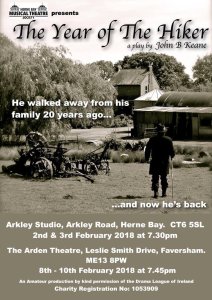
The play is The Year of the Hiker by John B. Keane. An Irish play first performed in 1963, it wasn’t one I’d ever heard of before. But I have grown to love it, as the characters have gradually revealed themselves during our rehearsal period. I am playing Joe Lacey, a young farmer who is forced to deal with some very complicated feelings. His father left 20 years ago, but returns in the play’s second scene. Joe has to work out how he feels about this and what to do when the reasons for his father’s return are revealed. He also has to negotiate a stormy relationship with his younger brother, and the conflicting demands of his other family members.

For the first act, Joe’s true feelings remain unseen. We see some flashes of anger, but not the reasons for them. We see that he doesn’t smile or laugh as much as his relatives, but we don’t find out why. This all comes out in a flood during the final scene, in one of the most emotional moments I have ever had to play. There is some resonance with characters I played in Footloose and When Midnight Strikes, dealing as they did with suppressed emotion in one case and serious daddy issues in the other. The balancing act of portraying a character who has all of this underneath the surface is hard – his eventual outburst needs to be surprising, yet not come out of nowhere.

When I do a musical, I can come offstage aching and sweaty. With the play, neither of these are true, yet I am still exhausted. Playing Joe is emotionally draining. And there are times during the play (particularly in the second act) when I don’t dare go back to the dressing room and sit down, despite having long periods offstage. To do that would break the spell – standing alone in the darkness backstage helps maintain my mood and focus. A musical requires a great deal of concentration too, but the need to stay in my character’s world here has a different quality to it, is more intense. I’m sure the professionals could cope much better, and snap into character in a moment, but I can’t, not for this. I need a bit of a run up!

Some audience members have told me that the show, and particularly one of my moments, has made them cry. I can’t remember anyone saying that since Footloose back in 2010. And there are times – not every time – when I really feel it, like a punch to the gut. I feel his hurt and anger, his bitterness, his incomprehension, his fortitude and later his lack of it. Some actors say they always experience this, that if they don’t feel the character’s emotions themselves, they can’t portray them. I don’t hold with that, but it is a powerful and somewhat frightening thing when it does happen to me.

It is often said of musicals that characters sing when words alone aren’t enough. Joe is a character who metaphorically can’t sing. He can hardly express himself in speech, and if an underscore were to start, I believe that there would be no melody, no harmony, no dance steps for him. His ability to sing and dance left him when his father walked out. He had to grow up overnight, and for Joe, part of that was leaving anything fun behind him. We get a hint that he had a social life, even a love life, once upon a time, but even that would have been a quiet, unemotional thing. As he puts it (speaking of filial affection) when he finally allows himself to sit down and talk to his father, “that kind of feeling isn’t in me.”

With two performances left, I am proud of what I have achieved here. I have proved to myself that I can act, not sing or perform (though I can do those things), but act. Take on a character and move an audience without the aid of music. And even when I’ve tied myself in knots with the script once or twice, I have been able to extricate myself and my fellow actors while remaining in character.

Will I do a play again? Absolutely. And hopefully it won’t be another 22 year gap between The Year of the Hiker and the next one, as there was between A Doll’s House and this. But I’m not going to give up musicals. Each is deeply challenging, each is deeply rewarding. The processes are much the same, but they feel so different and give differing qualities of satisfaction. I suspect I will remain a musicals man primarily, but now I know that I can be happy not singing.

The Year of the Hiker - flyer