Archive for the ‘ Theatre ’ Category

Wetly done indeed!


Last week, I headed to the picturesque surroundings of St Augustine’s Abbey in Canterbury to see a play.  I have attended a number of Shakespeare productions there before, including a particularly good version of Much Ado About Nothing, and it has proved to be an atmospheric location for an evening of outdoor theatre.  The play on this occasion was Heartbreak Productions‘ adaptation of Jane Austen’s Emma.  Before I discuss the play, though, there is one thing I need to address.  It rained.  A lot. Continue reading

Audiences – a vital ingredient


Theatre does not exist without an audience.  Live performance of any kind is only really performance if it is being watched – if not, then it might as well be a rehearsal, a game or a private jam session.  This is not simply due to the ego of those acting, singing or dancing, but it is a result of the vital role that audiences play. 

At any theatrical performance, the audience can enhance or detract from the production on offer.  Mobile phones, flash photography and random talking can be distracting (sometimes dangerous) for the cast and irritating for fellow theatregoers.  A badly timed noise can break the spell in a tense or moving moment, puncturing the suspension of disbelief that has been built up and reminding everyone that they are, after all, watching people pretending to be other people in a small, dark, warm building with mildly uncomfortable seats. 

For the actor, the response of the audience can be vital.  Continue reading

Cooling down


It has been just over a week now since the final performance of Hot Mikado, and I am still getting people come up to me and tell me how much they enjoyed the show.  Part of this was due to the standard of the performances, apparently, but part of it was because the show has a real fee-lgood factor.  Bright colours, lively music, a happy ending and even (in our production) a shower of confetti during the finale – all ingredients which added up to a cast having great fun and audiences leaving with big smiles on their faces.

We didn’t please everyone, of course, though you never do.  But I had a fantastic time, we had a lot of laughs backstage and we heard a lot of laughs coming from the auditorium.  The highlight for me was the act one finale, which was a sequence where for all intents and purposes I stopped being my character and was simply ‘a gentleman of Japan’, merrily celebrating the impending nuptials of the romantic leads and/or reviling Katisha, the older woman.  It was a joyous explosion of music and dance, and I always looked forward to the moment when the men strutted out with their tambourines, heralding a shift in time signature and hot, hot gospel.  The various facial expressions in the audience were a joy to behold, changing from horror (there must be many people who had traumatic tambourine incidents as children) and puzzlement at first to excitement and exuberance as we worked towards the finale’s climax.  Dancing my bright orange socks off and exclaiming ‘Joy, joy, joy!  Joy reigns everywhere!’, I could not help but grin, and I’m certain our enthusiasm spilled out into the audience.

Joy really did reign everywhere around.

We are gentlemen of Japan!


What happens if you cross the satirical wit and sparkling melody of Gilbert & Sullivan with flashy waistcoats, tap dance, close harmony and a whole bucket of Brylcreem? You get Hot Mikado, that’s what you get, and that’s what I’m doing all this week, up at the Gulbenkian Theatre in Canterbury.

I play a fellow who delights in the name of Pish-Tush, the coolest Gentleman of Japan (or at least, that’s how he sees himself). I spend much of the show either sneering at the other characters in disdain or dancing my bright orange socks off – some of the time, I’m even doing both, which is an exciting challenge. The musical style of the show is rooted in the 1940s, with blues, swing, scat and scorching hot gospel combining to give the score an uplifting ‘zing’. The ‘Three Little Maids’ sing their number beautifully, in a close harmony arrangement which sounds like an Andrews Sisters number, and Katisha, the femme fatale, displays an amazing gospel voice which utterly blows me away even as Pish-Tush mocks and sneers at her.

I’m fairly certain that this show gives me more to do than any other recent show, even though Pish really is the most minor of the principals. In addition to a male trio where I take the top line and a quartet where I take the bass line (a ridiculous range from top note to bottom note is required!), I’m involved with all of the chorus numbers which gives me a wide variety of harmonic and choreographic challenges – my heart races so fast at the end of the first act, simply due to the high energy of the dance routine, that I worry for my health. Thankfully, I sit the big tap dance out (it’s really not in my skill set), and instead provide backing vocals for the number as I kowtow to the Mikado (the only person Pish-Tush remotely respects). My head is spinning with everything I have to remember, and there are still a couple of tricky corners which I’m not 100% confident about. Seven syllables of ‘Swing a Merry Madrigal’ will probably haunt my nightmares forever – how hard can it really be to sing “Hey bob-a-ree-bob swee-dee-pow”? Harder than you’d think! Still, exhausting as it is, I’m absolutely loving it. Putting it on before an audience for the next five days will be a complete and utter joy.

CD of the moment: Act One


I have [mumblemumble]hundred theatre-related CDs in my collection, and some of them inevitably get listened to a lot more than others.  I was recently asked to write a CD review (which was not used), so I thought I’d tweak it a little and share it here, potentially with the aim of posting a review of a recording at the beginning of each month.

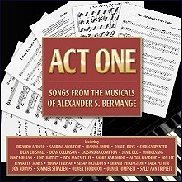
Act One CD Cover

Act One CD Cover

Act One: Songs from the Musicals of Alexander S. Bermange

Dress Circle 070 501-8 – RRP: £14.99
 
Alexander S. Bermange’s name may not be familiar to the majority of theatre fans, but the people who interpret his songs on this recording almost certainly are. The 26 singers include leading men such as Jon Lee, Earl Carpenter and Daniel Boys, while the distaff side is equally strong, featuring Sally Ann Triplett, Joanna Ampil, Lara Pulver and Summer Strallen among others. As Sir Tim Rice says in his brief liner notes, this surely speaks volumes about the quality of the material they are interpreting, and they all give their songs all they’ve got. Mr Bermange has mostly been successful in continental Europe, which has seen productions of his various musicals based on tales from the likes of the Brothers Grimm. Several selections from these shows are included here along with others representing a total of ten musicals and one pantomime. The numbers themselves cover power ballads, love songs and comedy moments, showing great versatility from the composer-lyricist, who plays piano on all bar one of the tracks.

Each track is rewarding listening, but some stand out immediately. The disc opens with ‘Walking On the Sun’, which is reminiscent of  ‘This is the Moment’ in some ways, though the lyrics of the verses are somewhat puzzling – perhaps they make more sense in the context of the show it comes from. Three songs from Odette, an adaptation of Swan Lake, are particularly enjoyable. Each of the main characters familiar from the ballet is represented in these selections, and all of them use fairy tale metaphors, an interesting touch which provokes questions about the rest of the show, suggesting an unusual level of awareness on the part of the characters – do they know they’re part of a story, I wonder? Best of these is ‘My Prince’, sung by Lara Pulver (now appearing as Isabella in the BBC’s Robin Hood), a comic number in which Odile reveals the many ways in which she has tried to attract a Prince Charming using every trick in the fairy tale book. The sadder side of love is explored by Janie Dee in ‘Where’s the Love?’ from Close Encounters and by Jenna Lee-James and Dean Collison in ‘Anyone But You’ from Thirteen Days. Both tracks pull at the heart strings, exploring two complex relationships, ill-advised in different ways.

For me, though, it is two of the upbeat tracks which prove to be the cream of the already very good crop on the CD, both of them written for a pantomime version of Aladdin at the Pleasance Theatre. While they may not be deep or complex (not concepts you usually associate with panto), ‘I Want to Reach the Stars’ (sung by Jon Lee) and ‘Higher Than a Shooting Star’ (Mark Evans and Susan McFadden) are highly engaging, great examples of the ‘I want’ and ‘I love you’ genres, essential inclusions in any theatre score, and leave the listener with a huge smile. This CD proves that Stiles and Drewe are not the only hope for the future of British musical theatre, and makes you long to hear more from Mr Bermange – here’s hoping for an Act Two!

Speak up!


I have recently been asked, in two completely different contexts, about how to project the voice.  One query was from someone who has a very, very quiet speaking voice and would quite like to be heard, and the other was from a group of young people about to do a performance.  It struck me that although, in theory, I’m a good person to ask about this, given how often I have to project my voice, it was a very difficult question to answer.  How, exactly, do I project my voice?

I know I was never specifically taught projection techniques of any kind – it was a skill I somehow picked up naturally.  This is a strange thing, because in ‘real’ life, I am often difficult to hear.  I can mumble quite unintentionally and very often have to be asked to repeat what I’ve said.  Yet, put me on a stage and suddenly I can be heard.  Projection also comes in handy when getting users of the Library of Doom to be quiet – sometimes it’s necessary to get a whole roomful of people to turn the volume down.

When I thought about it, I realised that projection has something to do with breathing, something to do with confidence, something to do with psychology and something to do with posture.  The sound has to come from further down, starting deep down inside you rather than in your throat.  There has to be enough air in your lungs to support it.  You have to imagine that you’re speaking or singing directly to someone who is quite far away.  And you absolutely do not have to shout – persistent shouting instead of projecting hurts and would probably ruin the voice if it was tried for too long.

Explaining a process that I don’t entirely understand proved to be a difficult task.  It’s hard to explain how to breathe or how to think yourself into projection.  It made me realise once more how much a mystery performing is to many people.  As well as all the joy of creating a character, and the great conundrum of ‘how do you learn the lines?’, there are a great many technical bits and pieces that evidently aren’t as normal and natural as years of doing them might make them feel.  There’s an art to speaking up and speaking out – now I just need to learn how to apply that art, in a minor way, to conversation.  Speak up, Singing Librarian!

The Very Model?


I like to keep myself on my toes when performing, preferring not to do the same sort of thing twice if I can avoid it.  Thus, having played several ‘young, silly and in love’ roles in musicals over the last few years, I’ve just spent a week as Major General Stanley in The Pirates of Penzance.  To be fair, the Major General is more than a little silly, but he is definitely not young and the only thing he’s in love with is the idea of staying alive.  I’m always happiest playing character parts, and he is most definitely a character and a half, alternating between stroppy and snivelly for much of his stage time.  The part also shares something in common with many of my roles, in that it has maximum impact for minimum stage time – thanks largely to that wonderful patter song.  I can’t imagine there are many people who’ve never heard ‘I am the very model of a modern major general’ before.

As I was one of the youngest members of the cast, yet played the father or potential father-in-law of more than a dozen people, this involved both a long time sorting out hair and make-up and a lot of concentration.  The grey hair, bushy sideburns and wrinkles did a lot of the work in creating the illusion of being old, but I still had to remember at every moment that I should not be able to move quickly and easily as I can.  In the first act, I had a walking stick to lean on, which helped keep my back bent, but I had no such aid in the second act (only a handkerchief, which saw more use than most props tend to) and often caught myself being more upright than I should have been.  A slow sag was necessary to regain the proper posture without drawing attention to it.

As with many shows, I spent some time singing in the wings, both as an honorary pirate and an honorary policeman, adding to the chorus vocals.  In rehearsals, I also sang along with the numbers for the Major General’s daughters, but refrained from doing so in performance.  Wing-singing gives me something to do when I’m off-stage and in this case meant that I didn’t miss out on some of the best parts of the show, most notably ‘With Cat-Like Tread’, which is a fantastic sing.

Because I am who I am, I was acutely aware of every mistake I made, large or small, particularly in the patter number.  I had a strange problem in rehearsals, getting my animals and vegetables mixed up in the phrase “In short in matters vegetable, animal and mineral, I am the very model of a modern major general”, and this certainly happened in performance as well, though not quite so spectacularly.  “Babylonic cuneiform” also defied pronunciation one night and I managed not to sing one phrase at all on one occasion, a I was so busy acting (a feat which the Pirate King then echoed during our dialogue scene later).  It is very difficult not to let mistakes prey on your mind for the rest of the performance, even if they’re so small that even your fellow performers fail to notice them.

Did I enjoy it?  Yes, I did, particularly the last performance, where I felt I could just let go and stop worrying about it.  I enjoyed the opportunity to add another string to my performing bow – the patter song.  I enjoyed working with a talented, supportive cast (in very cosy conditions backstage!).  I enjoyed everyone’s reactions to seeing the hair and make-up job for the first time.  And I enjoyed my first fully-staged Gilbert and Sullivan production.  Many audience members said they were surprised how much they enjoyed it and how much they laughed.  It just goes to show that the two men’s work is not anywhere near as dated as people often think.  There are rich veins of beauty and humour to be mined, and I look forward to mining them many times more in the future.

Quite a compliment


Recently, someone who was on the audition committee for a show said that I caused great difficulty during the casting process.  Naturally, I apologised (I’m good at apologising, particularly if the apology is needless), but was soon reassured that this was not a bad thing.  Apparently, they could have slotted me in anywhere, which made the decision about what to do with me harder than it otherwise might have been.  A strange thought, but on reflection, it’s possibly one of the nicest compliments I’ve ever received.  What better praise can there be for a performer than to have their flexibility or adaptability noted?  It’s nice to know that I’m a versatile singing librarian.

Wardrobe malfunction!


It was one of those moments when you really hope that nobody in the audience is looking your way.  If I’m lucky, all eyes were centre stage gazing adoringly at Aladdin and Princess Jasmine.  In the final few seconds of last night’s show, you see, I had a serious wardrobe malfunction.

The Genie costume took a little bit of getting used to for me, as it exposes more flesh than I am accustomed to exposing and certainly could not be worn by a lady librarian.  The main items are some baggy trousers, a hat, two cuffs and a diamond-shaped thing that covers my shoulders and bits of my chest and back, attaching to the front and back of the trousers via two of the diamond’s points.  It was intimidating at first (and has required the use of fake tan to avoid the make-up procedure taking several days), but I have become accustomed to it and can now say that it is a great costume.  When it behaves itself, that is.

Last night, happily singing and dancing my way though the big finale song, I reached a moment when the principals are all on a raised platform while the dancers do crazy stuff below us and realised that my costume was coming adrift.  It is held together at the front by two hooks and eyes and a popper.  The popper had come undone and I hastily reaffixed it during the next bout of hectic freestyle movement, making sure that my back was to the audience.  All was well, or so I thought.

Perhaps my next few movements (we were very near the end) were more violent than usual.  Perhaps something was in the air (others had costume issues as well).  Who knows.  But in the final couple of bars, we all take a final bow.  As we did so, the hat decided to make its presence known and I struggled to keep it on.  We stood up, and I felt pleased with myself for not losing it, but worse was to come.  On the final beat of the music we all stretch an arm up high and grin madly.  I stretched, and all three fastenings came undone as my costume made a bid for freedom.  I had to grab hold as quickly as possible to prevent the diamond flying too far up and the trousers falling down (they are only figure-hugging near the ankles) and as the lights went out, the hat finally decided enough was enough – it did not want to be on my head for another second.  Blackout, front cloth in and…laughter.  Trying to hold my errant costume together, I could not help but laugh.  I had no idea if the audience had noticed (if they had, they’d have gained a very brief glimpse of a lot more Genie chest than they were accustomed to), or if the director had noticed.  At the beginning of the run, I’d have been mortified and horribly embarrassed, but nine performances in, it just struck me as hilarious.  How a week can change your point of view!

Panto frolics


Well, Aladdin at the Margate Winter Gardens is well under way, and the cast and crew are enjoying a day off, all hoping to recover enough energy and vocal strength to continue through the next week’s performances. It has been a lot of fun and a lot of stress, a general roller-coaster of emotions and activity. The audiences seem to be enjoying themselves, which is the aim of any pantomime (the genre should function as a theatrical ‘gateway drug’, getting kids hooked on theatre) and we have continued on, despite the inevitable technical hitches and a fainting Chinese policeman. We have thus far given five performances complete with everything from malfunctioning mangles to singing clouds, puffs of smoke to unexpected audience participation, all the ingredients of a fun panto.

I spend quite a bit of the show either sitting in my dressing room or pacing the corridors, and have discovered that the latter is inadvisable if the junior dancers are around – apparently either I or my make-up is (or am) terrifying in semi-darkness, causing them to jump, start or squeal. Some younger audience members also seem to find the Genie disturbing, though one young person did tell the Dame that his favourite bit of the panto was when I appeared – hearing about this cheered me up somewhat.

Many things about the show are a joy and it has not yet become routine for me. The cast are amazing, on stage and off, from Widow Twankey who can ad lib her/his way out of any sticky situation, to Aladdin, who has shown such openness and determination to learn new skills. Many of us have been on a steep learning curve and we are constantly on our toes. Some particular joys for me:

Dodging dancers. During some numbers, I provide off-stage backing vocals, and in one of these there is a dance break, where I must remember to clear a space for K, one of the incredibly talented senior dancers, to jog past as he exits and re-enters the scene. I have no idea whether he sees me smile and nod to him as he goes past, but I find the moment strangely reassuring, a sign that the show is going as it should.

Waiting for the pop. As is traditional, the Slave of the Ring and the Genie of the Lamp appear in a puff of smoke. There is a health and safety side to this, as any actor too close to the pyro which provides the smoke could easily be burned, so our mantra as we are about to enter is ‘wait for the pop’. On one occasion I got confused, or possibly over-excited, and failed to wait for the pyro to go pop, so I had no puff of smoke. Entirely my fault. Of course, I now get a significant look from the pyro-man every time I’m about to enter to remind me not to do it again.

Listening in. The show relay is a very handy thing, allowing actors in far-off dressing rooms to hear what’s going on and thus know when their scenes are approaching. During Aladdin, it has also been a source of amusement to me. Having seen the scenes so many times in rehearsal, I know how things are supposed to go, so it’s always interesting listening for deviations and wondering what’s gone wrong (or unexpectedly right) at any given moment. Hearing Widow Twankey ask one of the crew to remove a stray prop or the Chinese policewomen get confused about which one of them is which is almost as funny as seeing it unfold in front of me. More intriguing is trying to work out why someone says “oh, that was unexpected!” or similar. The thrill of live theatre is possibly never more evident than in panto when it seems absolutely anything can (and does) happen.

Freestlying. Actually, if we’re listing joys, that’s a lie. In choreographic terms, I don’t think there is any word that’s more scary than ‘freestyle’, at least to a non-dancer like myself. There are parts of the big finale that are freestyle, but I think most of us principals have settled ourselves into a routine for those moments, and do essentially the same ‘freestyle’ moves each time. Anyway, by the time we reach freestyle, I’m having so much fun that I can’t help but smile even if I have a blank and can’t think what to do.

Tired as I am, this has thus far been an amazing experience, quite unlike anything else I’ve done on stage thus far.  I have cried with laughter and cried with frustration.  I have invented a new key to sing in (though thankfully have not returned to it) and danced my socks off (if one who is barefoot can be said to dance their socks off).  I have met new people and got to know others better.  And I only have a week more of it to go.  I’ll be a little relieved when it’s over, but I know I’ll miss it.  It has been wonderful to have a licence to be utterly daft for a few weeks and the sound of the audience shouting “it’s behind you!”, even if they’re not actually shouting to me, is a sound to be treasured.